The More You Know...
Our blog shares practical guidance, expert takes, and real-world lessons drawn from the front lines of IT services. Stay informed, stay protected, and make smarter decisions for your business.
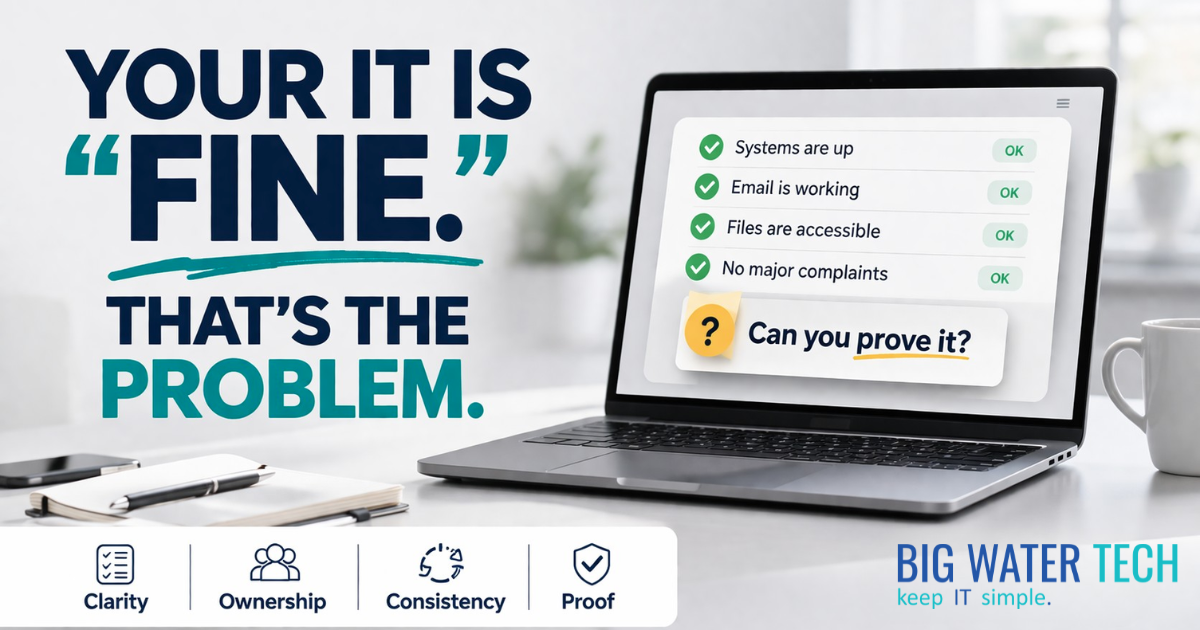
Your IT Is Probably “Fine.” That’s the Problem.
Why “Nothing’s Broken” Is the Most Dangerous IT Status for Michigan SMBs
For most Michigan business owners, IT isn’t something you think about every day.
And that’s usually a good sign.
Your systems are up.
Your team is working.
Clients aren’t complaining.
So let’s start with a simple question:
If nothing is broken, why would IT be a problem?
Because “fine” doesn’t mean protected.
It doesn’t mean reviewed.
It doesn’t mean documented.
And it definitely doesn’t mean you’re prepared when someone asks for proof.
What does “fine” IT actually mean in a business?
In most firms, “fine” means:
Email works
Files are accessible
Staff can do their jobs
No one is actively frustrated
That’s operational success.
But here’s the real question:
Does working IT mean secure IT?
No.
Working IT means things function.
Secure IT means those systems are:
Monitored
Reviewed
Controlled
Documented
Most businesses have working IT.
Far fewer have managed and provable IT.
Why is “working IT” no longer enough?
Because the people evaluating your business have changed.
Today, your IT is being quietly judged by:
Cyber insurance carriers
Clients and prospects
Compliance requirements
Your own internal risk
So instead of asking:
“Is everything working?”
They’re asking:
Can you prove your IT is secure and controlled?
And that’s where “fine” starts to fall apart.
What are the hidden risks in IT that looks fine?
This is where most Michigan SMBs get caught off guard.
Nothing looks wrong… until you look closer.
Ask yourself:
Do former employees still have access?
Are shared logins being used?
Have your backups ever been tested?
Are your security tools actively monitored or just installed?
Do vendors still have access you forgot about?
If you’re not reviewing these regularly, how would you know?
That’s the gap.
Why do businesses fail audits or cyber insurance reviews?
It’s rarely because systems are broken.
It’s because there’s no proof.
Here’s what you’ll actually be asked:
Is MFA enforced everywhere?
When was your last access review?
Can you show who has access to sensitive data?
Are backups tested and documented?
Do you have an incident response plan?
What happens if you can’t answer those questions clearly?
Delays. Higher premiums. Failed audits. Lost opportunities.
Not because you did something wrong.
Because you can’t prove what’s right.
What does “proof” in IT really mean?
This is where many firms get stuck.
So let’s simplify it:
What counts as proof in cybersecurity and compliance?
Proof is:
Reports showing access reviews
Logs showing systems are monitored
Backup test results
A current list of users and devices
Documented policies that match reality
If someone asked today, could you produce that in minutes… or would it take days?
That answer tells you everything.
How often should IT actually be reviewed?
Another question business owners ask:
Is IT something you set up once… or something you revisit regularly?
In today’s environment:
Access should be reviewed regularly
Backups should be tested routinely
Security controls should be validated consistently
If nothing is being reviewed, what’s changing without you knowing?
That’s where risk builds quietly.
What does good IT look like for a small business?
This is where we simplify things.
Do you need more tools… or better structure?
For most 10 to 50 person firms, it looks like:
A clear list of systems, users, and vendors
Regular access cleanup
Verified backups
Security tools that are actively monitored
A simple incident response plan
Regular business-level IT reviews
Notice what’s missing?
More complexity.
Good IT is structured. Not complicated.
Why does this matter more for accounting, legal, and medical firms?
Because your business runs on trust.
So ask yourself:
What would happen if a client asked how you protect their data?
Or worse:
What happens if you have to explain it after something goes wrong?
Across Michigan, firms are seeing:
More client security questions
More insurance scrutiny
More compliance expectations
Is “we think it’s fine” a strong answer in that moment?
It isn’t anymore.
What is the biggest mindset shift business owners need?
This is the one that changes everything:
Stop asking:
“Is everything working?”
Start asking:
Could we prove it if someone asked?
That shift moves your business from:
Reactive → intentional
Assumed → verified
Operational → protected
Final Thought: Where Is Your Business Right Now?
Let’s bring it back to one simple question:
Is your IT truly managed… or just quietly working in the background?
Most firms don’t have bad IT.
They have unexamined IT.
And in today’s environment, that’s the real risk.
Call to Action
If your IT feels “fine,” you’re not alone.
But now is the right time to ask a better question.
Do you actually know what you have, and can you prove it?
We help Michigan businesses answer that clearly.
No pressure. Just a conversation that gives you clarity on where you stand today.

Your IT Is Probably “Fine.” That’s the Problem.
Why “Nothing’s Broken” Is the Most Dangerous IT Status for Michigan SMBs
For most Michigan business owners, IT isn’t something you think about every day.
And that’s usually a good sign.
Your systems are up.
Your team is working.
Clients aren’t complaining.
So let’s start with a simple question:
If nothing is broken, why would IT be a problem?
Because “fine” doesn’t mean protected.
It doesn’t mean reviewed.
It doesn’t mean documented.
And it definitely doesn’t mean you’re prepared when someone asks for proof.
What does “fine” IT actually mean in a business?
In most firms, “fine” means:
Email works
Files are accessible
Staff can do their jobs
No one is actively frustrated
That’s operational success.
But here’s the real question:
Does working IT mean secure IT?
No.
Working IT means things function.
Secure IT means those systems are:
Monitored
Reviewed
Controlled
Documented
Most businesses have working IT.
Far fewer have managed and provable IT.
Why is “working IT” no longer enough?
Because the people evaluating your business have changed.
Today, your IT is being quietly judged by:
Cyber insurance carriers
Clients and prospects
Compliance requirements
Your own internal risk
So instead of asking:
“Is everything working?”
They’re asking:
Can you prove your IT is secure and controlled?
And that’s where “fine” starts to fall apart.
What are the hidden risks in IT that looks fine?
This is where most Michigan SMBs get caught off guard.
Nothing looks wrong… until you look closer.
Ask yourself:
Do former employees still have access?
Are shared logins being used?
Have your backups ever been tested?
Are your security tools actively monitored or just installed?
Do vendors still have access you forgot about?
If you’re not reviewing these regularly, how would you know?
That’s the gap.
Why do businesses fail audits or cyber insurance reviews?
It’s rarely because systems are broken.
It’s because there’s no proof.
Here’s what you’ll actually be asked:
Is MFA enforced everywhere?
When was your last access review?
Can you show who has access to sensitive data?
Are backups tested and documented?
Do you have an incident response plan?
What happens if you can’t answer those questions clearly?
Delays. Higher premiums. Failed audits. Lost opportunities.
Not because you did something wrong.
Because you can’t prove what’s right.
What does “proof” in IT really mean?
This is where many firms get stuck.
So let’s simplify it:
What counts as proof in cybersecurity and compliance?
Proof is:
Reports showing access reviews
Logs showing systems are monitored
Backup test results
A current list of users and devices
Documented policies that match reality
If someone asked today, could you produce that in minutes… or would it take days?
That answer tells you everything.
How often should IT actually be reviewed?
Another question business owners ask:
Is IT something you set up once… or something you revisit regularly?
In today’s environment:
Access should be reviewed regularly
Backups should be tested routinely
Security controls should be validated consistently
If nothing is being reviewed, what’s changing without you knowing?
That’s where risk builds quietly.
What does good IT look like for a small business?
This is where we simplify things.
Do you need more tools… or better structure?
For most 10 to 50 person firms, it looks like:
A clear list of systems, users, and vendors
Regular access cleanup
Verified backups
Security tools that are actively monitored
A simple incident response plan
Regular business-level IT reviews
Notice what’s missing?
More complexity.
Good IT is structured. Not complicated.
Why does this matter more for accounting, legal, and medical firms?
Because your business runs on trust.
So ask yourself:
What would happen if a client asked how you protect their data?
Or worse:
What happens if you have to explain it after something goes wrong?
Across Michigan, firms are seeing:
More client security questions
More insurance scrutiny
More compliance expectations
Is “we think it’s fine” a strong answer in that moment?
It isn’t anymore.
What is the biggest mindset shift business owners need?
This is the one that changes everything:
Stop asking:
“Is everything working?”
Start asking:
Could we prove it if someone asked?
That shift moves your business from:
Reactive → intentional
Assumed → verified
Operational → protected
Final Thought: Where Is Your Business Right Now?
Let’s bring it back to one simple question:
Is your IT truly managed… or just quietly working in the background?
Most firms don’t have bad IT.
They have unexamined IT.
And in today’s environment, that’s the real risk.
Call to Action
If your IT feels “fine,” you’re not alone.
But now is the right time to ask a better question.
Do you actually know what you have, and can you prove it?
We help Michigan businesses answer that clearly.
No pressure. Just a conversation that gives you clarity on where you stand today.