
Are You Paying Twice for IT, or Leaving Something Uncovered?
“We already have an IT company. Why do we need someone else?”
It’s a fair question when someone recommends a security assessment or a virtual Chief Information Security Officer, usually called a vCISO. You’re already paying for IT support, and you expect that relationship to include protecting the business. Then someone introduces an MSSP or a governance, risk, and compliance service, and it sounds like another invoice for work you thought was covered.
There is overlap between these services. There are also responsibilities that get missed because everyone assumes they belong to someone else. Before adding another service, you need to understand what your current agreement covers and what the additional work will accomplish.
What is the difference between an MSP, an MSSP, and a GRC service?
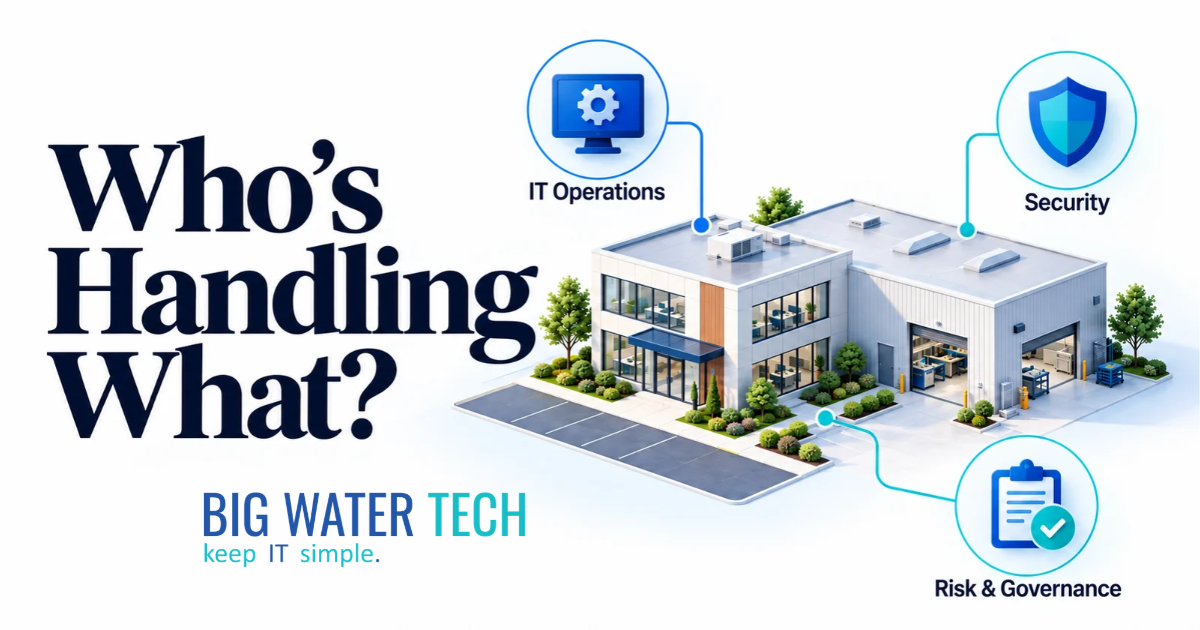
An MSP manages technology operations. An MSSP specializes in operating cybersecurity services. A GRC service helps leadership manage risk and meet business obligations. One provider can perform several of these functions, depending on its capabilities and your agreement.
The leadership roles fit within that picture. A vCIO guides technology decisions around business needs. A vCISO leads the cybersecurity program and helps management make informed security decisions.
Service or role | Primary focus | Example of the work |
|---|---|---|
MSP: Managed Service Provider | Supporting and managing business technology | Maintaining systems and resolving employee technology problems |
MSSP: Managed Security Service Provider | Operating cybersecurity services | Investigating suspicious activity and taking authorized response actions |
vCIO: Virtual Chief Information Officer | Technology direction and investment | Planning technology requirements and spending for another location |
vCISO: Virtual Chief Information Security Officer | Cybersecurity leadership | Establishing security priorities and overseeing progress |
GRC: Governance, Risk, and Compliance | Risk oversight and business requirements | Maintaining a risk register and documenting evidence for customer security obligations |
These are typical responsibilities. The label on a proposal doesn’t establish the scope of the service, and having one of these services doesn’t automatically cover the others.
What should your MSP be responsible for?
Your MSP should manage the technology and support responsibilities defined in your agreement, including the security services you have purchased. That generally includes ongoing system administration and employee support, but coverage varies considerably.
CISA recommends that providers and customers clearly identify ownership of security responsibilities in their contracts. That matters because an assumption about coverage is difficult to resolve while an incident is underway. www.cisa.gov
For a Michigan law firm, the MSP relationship might include Microsoft 365 administration and coordination with the document management vendor. For a manufacturer, it might include maintaining the network that connects office systems to production applications.
I expect a good MSP to understand how those systems affect the business. If an aging server supports your scheduling application, a replacement recommendation should arrive early enough for you to plan the spending and disruption.
That’s where vCIO involvement matters. The vCIO works with leadership on technology direction, including whether the current environment will support the company’s plans. A quarterly equipment report alone doesn’t provide that leadership.
Does having an MSP mean you also need an MSSP?
No. You need appropriate security capabilities, but those capabilities can already be part of your MSP relationship. Some MSPs operate security services themselves. Others use specialist partners to deliver them.
An MSSP focuses on services such as security monitoring and alert investigation. Its agreement determines whether it also contains threats or performs broader incident response.
The practical question is what happens after an alert appears. If suspicious activity occurs at 2 a.m., does someone investigate immediately? Can they isolate an affected computer without waiting for your office to open?
There’s a substantial difference between receiving a notification and having someone authorized to act. “Security monitoring included” doesn’t explain which service you bought.
Before signing another contract, ask your MSP to explain its existing coverage, including any security partners and the limits of their response authority. You need to understand where responsibility passes from one team to another.
How is a vCIO different from a vCISO?
A vCIO guides technology decisions across the business. A vCISO leads the cybersecurity program and advises management on security risk. Both roles require planning and follow-through.
Your vCIO helps evaluate whether your technology supports business operations and future investment. Your vCISO establishes security priorities and oversees whether the organization addresses them.
Suppose a manufacturer plans to acquire another company. The vCIO evaluates how the technology environments will fit together and what integration will cost. The vCISO evaluates the security exposure involved in connecting them and establishes the conditions for doing so.
Calling the vCIO a doer and the vCISO a planner gives part of the picture, but it leaves too much out. A vCIO needs to plan beyond the next project, and a vCISO needs to ensure recommendations lead to completed work.
These roles overlap because technology decisions have security consequences. They still need defined responsibilities, even when the same provider supplies both services.
What does a GRC service add to managed IT?
A GRC service turns risk decisions and business obligations into an ongoing program with assigned ownership and documented evidence. It connects what leadership has agreed to do with what actually happens.
For a manufacturer, the trigger is often a customer contract with security requirements. For a law firm, it might be a client’s vendor questionnaire asking for documented access reviews or evidence of an incident response exercise.
Someone needs to determine what each requirement means for the business, identify gaps, and assign the work. Someone also needs to track completion and keep the supporting evidence current.
A vCISO can lead that program through a GRC service. Technical implementation often remains with the MSP or internal IT staff, while management retains authority over business risk decisions.
NIST’s Cybersecurity Framework 2.0 includes governance because cybersecurity requires leadership decisions about accountability and acceptable risk. Those responsibilities exist alongside technical protection and response. nvlpubs.nist.gov
How do these services work together when a critical vulnerability is found?
Consider a manufacturer whose security scan identifies a critical vulnerability in the server supporting its production application. The software vendor requires testing before the update can be installed, and remediation will require downtime during a busy production week.
The security provider validates the finding and investigates whether there are signs of exploitation. The MSP works with the application vendor to establish a safe remediation process.
The vCIO helps operations understand the downtime and scheduling implications. The vCISO evaluates the exposure during the delay and works with the technical teams on temporary safeguards.
Management then decides whether the proposed delay is acceptable, based on the consequences of both acting and waiting. The GRC process records the decision, assigns a deadline, and tracks the evidence that remediation was completed.
One organization can handle several parts of that work. What matters is that the finding moves through to a verified resolution. A critical item sitting on a monthly report doesn’t establish that anyone owns it.
When are you paying twice for the same IT service?
Duplicate spending occurs when you pay for substantially the same work without a clear additional benefit. Two providers supplying similar monitoring across the same systems deserves examination.
Separate fees don’t automatically mean duplication. A provider operating security tools and a vCISO overseeing the security program perform different work. So do an MSP implementing access controls and a GRC team verifying that those controls satisfy an agreed requirement.
Ask each provider to identify its deliverables and explain how they connect. If both claim to “manage security,” they should be able to describe their responsibilities without leaving you to sort them out.
Additional oversight should produce decisions and completed work. Another report repeating findings you already know about needs a better explanation.
When does a small business need vCISO or GRC support?
Dedicated vCISO or GRC support becomes useful when security obligations exceed the time or experience available within the business. Employee count alone doesn’t settle the question.
That often happens when customer contracts introduce requirements that nobody currently owns. It also happens when internal IT staff understand the technical problems but need leadership support to resolve competing priorities.
A 25-person firm handling sensitive client information can have significant obligations. A larger company with established internal leadership might need targeted assistance with an assessment or an incident response exercise.
I’d look at the decisions going unmade and the work going unfinished before choosing a service level. An approaching audit creates urgency, but unresolved customer commitments are a reason to act earlier.
What should you ask before adding another IT or security service?
Start with your existing agreements and ask:
Who investigates security alerts, including after hours?
What response actions are they authorized to take?
Who owns remediation when several vendors are involved?
Who maintains policies and evidence for customer requirements?
Who presents unresolved risks to management?
Who verifies that corrective work was completed?
Put the answers in a responsibility matrix that includes internal staff and relevant software vendors. Each responsibility needs a named owner, with an escalation process for work that stalls.
You should also know what falls outside the agreement. If incident response is separately billed or compliance documentation remains your responsibility, that needs to be understood before you depend on the service.
How does Strata Advisory Group fit with Big Water Technologies?
Strata Advisory Group is Big Water Technologies’ GRC service, providing dedicated vCISO leadership and support for governance, risk, and compliance.
BWT’s managed IT relationship includes vCIO guidance alongside ongoing technology management and support. That helps clients plan technology investments around business needs.
Strata adds dedicated security leadership and risk oversight. Its work includes helping organizations establish security priorities and document risk decisions, along with preparing for customer or audit requirements. Strata coordinates with whoever handles technical implementation, whether that’s BWT, another provider, or internal IT.
For a manufacturer facing new customer security obligations, that means connecting the contractual requirements to assigned work and evidence of completion. For a professional services firm, it means giving leadership a clear view of its exposure and the decisions that need attention.
I wouldn’t recommend adding GRC services simply because your business reached a certain employee count. I would want to understand which responsibilities need attention and whether your existing team has the time and experience to cover them.
If you’re unsure what you’re paying for, ask Big Water Technologies to review your current coverage before adding another agreement. You should be able to see what each service covers and what still requires a decision from you. Paying someone to advise the business doesn’t transfer management’s accountability for the risk it accepts.

Ready For A No-Nonsense Approach To IT?
Hire us to set your IT strategy up for sustainable success.
Learn about our proven No-Nonsense approach.
Get an IT roadmap designed specifically for you.
Fearlessly grow your business.
Get in Touch with us!
Call us at (248) 220-7714 or or fill out the form below.
Categories
Featured Posts
Are You Paying Twice for IT, or Leaving Something Uncovered?
“We already have an IT company. Why do we need someone else?”
It’s a fair question when someone recommends a security assessment or a virtual Chief Information Security Officer, usually called a vCISO. You’re already paying for IT support, and you expect that relationship to include protecting the business. Then someone introduces an MSSP or a governance, risk, and compliance service, and it sounds like another invoice for work you thought was covered.
There is overlap between these services. There are also responsibilities that get missed because everyone assumes they belong to someone else. Before adding another service, you need to understand what your current agreement covers and what the additional work will accomplish.
What is the difference between an MSP, an MSSP, and a GRC service?
An MSP manages technology operations. An MSSP specializes in operating cybersecurity services. A GRC service helps leadership manage risk and meet business obligations. One provider can perform several of these functions, depending on its capabilities and your agreement.
The leadership roles fit within that picture. A vCIO guides technology decisions around business needs. A vCISO leads the cybersecurity program and helps management make informed security decisions.
Service or role | Primary focus | Example of the work |
|---|---|---|
MSP: Managed Service Provider | Supporting and managing business technology | Maintaining systems and resolving employee technology problems |
MSSP: Managed Security Service Provider | Operating cybersecurity services | Investigating suspicious activity and taking authorized response actions |
vCIO: Virtual Chief Information Officer | Technology direction and investment | Planning technology requirements and spending for another location |
vCISO: Virtual Chief Information Security Officer | Cybersecurity leadership | Establishing security priorities and overseeing progress |
GRC: Governance, Risk, and Compliance | Risk oversight and business requirements | Maintaining a risk register and documenting evidence for customer security obligations |
These are typical responsibilities. The label on a proposal doesn’t establish the scope of the service, and having one of these services doesn’t automatically cover the others.
What should your MSP be responsible for?
Your MSP should manage the technology and support responsibilities defined in your agreement, including the security services you have purchased. That generally includes ongoing system administration and employee support, but coverage varies considerably.
CISA recommends that providers and customers clearly identify ownership of security responsibilities in their contracts. That matters because an assumption about coverage is difficult to resolve while an incident is underway. www.cisa.gov
For a Michigan law firm, the MSP relationship might include Microsoft 365 administration and coordination with the document management vendor. For a manufacturer, it might include maintaining the network that connects office systems to production applications.
I expect a good MSP to understand how those systems affect the business. If an aging server supports your scheduling application, a replacement recommendation should arrive early enough for you to plan the spending and disruption.
That’s where vCIO involvement matters. The vCIO works with leadership on technology direction, including whether the current environment will support the company’s plans. A quarterly equipment report alone doesn’t provide that leadership.
Does having an MSP mean you also need an MSSP?
No. You need appropriate security capabilities, but those capabilities can already be part of your MSP relationship. Some MSPs operate security services themselves. Others use specialist partners to deliver them.
An MSSP focuses on services such as security monitoring and alert investigation. Its agreement determines whether it also contains threats or performs broader incident response.
The practical question is what happens after an alert appears. If suspicious activity occurs at 2 a.m., does someone investigate immediately? Can they isolate an affected computer without waiting for your office to open?
There’s a substantial difference between receiving a notification and having someone authorized to act. “Security monitoring included” doesn’t explain which service you bought.
Before signing another contract, ask your MSP to explain its existing coverage, including any security partners and the limits of their response authority. You need to understand where responsibility passes from one team to another.
How is a vCIO different from a vCISO?
A vCIO guides technology decisions across the business. A vCISO leads the cybersecurity program and advises management on security risk. Both roles require planning and follow-through.
Your vCIO helps evaluate whether your technology supports business operations and future investment. Your vCISO establishes security priorities and oversees whether the organization addresses them.
Suppose a manufacturer plans to acquire another company. The vCIO evaluates how the technology environments will fit together and what integration will cost. The vCISO evaluates the security exposure involved in connecting them and establishes the conditions for doing so.
Calling the vCIO a doer and the vCISO a planner gives part of the picture, but it leaves too much out. A vCIO needs to plan beyond the next project, and a vCISO needs to ensure recommendations lead to completed work.
These roles overlap because technology decisions have security consequences. They still need defined responsibilities, even when the same provider supplies both services.
What does a GRC service add to managed IT?
A GRC service turns risk decisions and business obligations into an ongoing program with assigned ownership and documented evidence. It connects what leadership has agreed to do with what actually happens.
For a manufacturer, the trigger is often a customer contract with security requirements. For a law firm, it might be a client’s vendor questionnaire asking for documented access reviews or evidence of an incident response exercise.
Someone needs to determine what each requirement means for the business, identify gaps, and assign the work. Someone also needs to track completion and keep the supporting evidence current.
A vCISO can lead that program through a GRC service. Technical implementation often remains with the MSP or internal IT staff, while management retains authority over business risk decisions.
NIST’s Cybersecurity Framework 2.0 includes governance because cybersecurity requires leadership decisions about accountability and acceptable risk. Those responsibilities exist alongside technical protection and response. nvlpubs.nist.gov
How do these services work together when a critical vulnerability is found?
Consider a manufacturer whose security scan identifies a critical vulnerability in the server supporting its production application. The software vendor requires testing before the update can be installed, and remediation will require downtime during a busy production week.
The security provider validates the finding and investigates whether there are signs of exploitation. The MSP works with the application vendor to establish a safe remediation process.
The vCIO helps operations understand the downtime and scheduling implications. The vCISO evaluates the exposure during the delay and works with the technical teams on temporary safeguards.
Management then decides whether the proposed delay is acceptable, based on the consequences of both acting and waiting. The GRC process records the decision, assigns a deadline, and tracks the evidence that remediation was completed.
One organization can handle several parts of that work. What matters is that the finding moves through to a verified resolution. A critical item sitting on a monthly report doesn’t establish that anyone owns it.
When are you paying twice for the same IT service?
Duplicate spending occurs when you pay for substantially the same work without a clear additional benefit. Two providers supplying similar monitoring across the same systems deserves examination.
Separate fees don’t automatically mean duplication. A provider operating security tools and a vCISO overseeing the security program perform different work. So do an MSP implementing access controls and a GRC team verifying that those controls satisfy an agreed requirement.
Ask each provider to identify its deliverables and explain how they connect. If both claim to “manage security,” they should be able to describe their responsibilities without leaving you to sort them out.
Additional oversight should produce decisions and completed work. Another report repeating findings you already know about needs a better explanation.
When does a small business need vCISO or GRC support?
Dedicated vCISO or GRC support becomes useful when security obligations exceed the time or experience available within the business. Employee count alone doesn’t settle the question.
That often happens when customer contracts introduce requirements that nobody currently owns. It also happens when internal IT staff understand the technical problems but need leadership support to resolve competing priorities.
A 25-person firm handling sensitive client information can have significant obligations. A larger company with established internal leadership might need targeted assistance with an assessment or an incident response exercise.
I’d look at the decisions going unmade and the work going unfinished before choosing a service level. An approaching audit creates urgency, but unresolved customer commitments are a reason to act earlier.
What should you ask before adding another IT or security service?
Start with your existing agreements and ask:
Who investigates security alerts, including after hours?
What response actions are they authorized to take?
Who owns remediation when several vendors are involved?
Who maintains policies and evidence for customer requirements?
Who presents unresolved risks to management?
Who verifies that corrective work was completed?
Put the answers in a responsibility matrix that includes internal staff and relevant software vendors. Each responsibility needs a named owner, with an escalation process for work that stalls.
You should also know what falls outside the agreement. If incident response is separately billed or compliance documentation remains your responsibility, that needs to be understood before you depend on the service.
How does Strata Advisory Group fit with Big Water Technologies?
Strata Advisory Group is Big Water Technologies’ GRC service, providing dedicated vCISO leadership and support for governance, risk, and compliance.
BWT’s managed IT relationship includes vCIO guidance alongside ongoing technology management and support. That helps clients plan technology investments around business needs.
Strata adds dedicated security leadership and risk oversight. Its work includes helping organizations establish security priorities and document risk decisions, along with preparing for customer or audit requirements. Strata coordinates with whoever handles technical implementation, whether that’s BWT, another provider, or internal IT.
For a manufacturer facing new customer security obligations, that means connecting the contractual requirements to assigned work and evidence of completion. For a professional services firm, it means giving leadership a clear view of its exposure and the decisions that need attention.
I wouldn’t recommend adding GRC services simply because your business reached a certain employee count. I would want to understand which responsibilities need attention and whether your existing team has the time and experience to cover them.
If you’re unsure what you’re paying for, ask Big Water Technologies to review your current coverage before adding another agreement. You should be able to see what each service covers and what still requires a decision from you. Paying someone to advise the business doesn’t transfer management’s accountability for the risk it accepts.
Enroll in Our Email Course

Learn How a No-Nonsense IT Strategy Benefits Your ComBullet listpany:
Strategies to allocate your IT budget efficiently
Enhance cybersecurity defenses on a bButtonudget
Ensure your technology investments continue to serve your business as it grows

Looking to Switch?
© Copyright 2026 Big Water Tech. All Rights Reserved. Built in partnership with Tech Pro Marketing | Privacy Policy | Client Portal | Areas We Serve


