
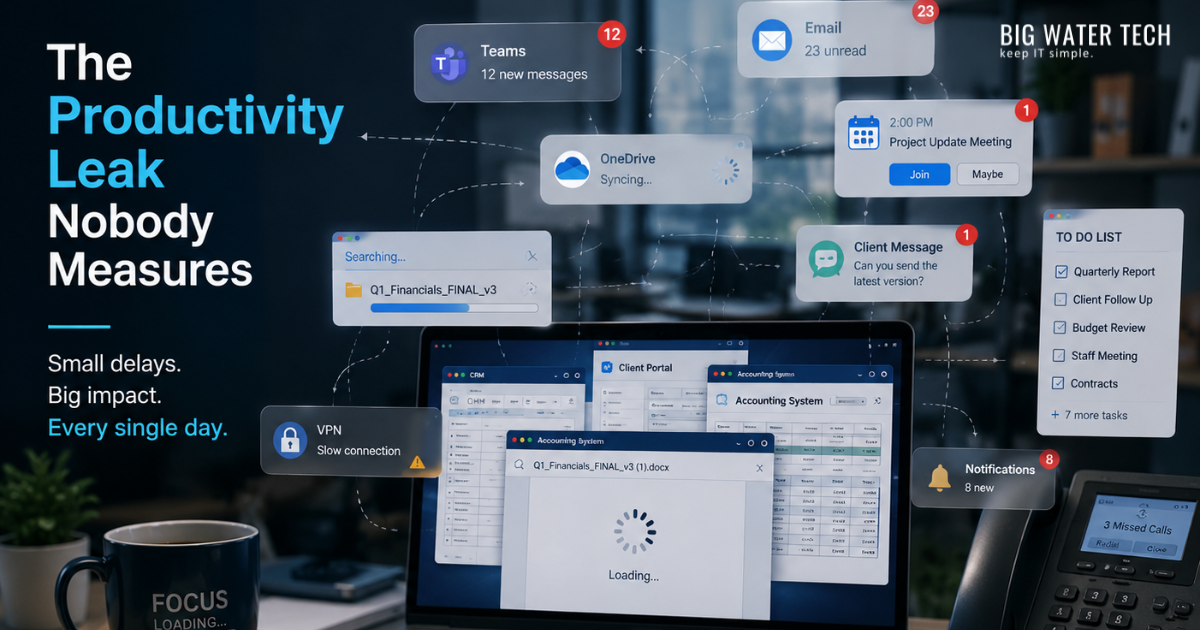
The Productivity Leak Nobody Measures
Why Small Daily Technology Friction Quietly Costs SMBs More Than Major Downtime
For many Michigan businesses, technology problems no longer look like major outages.
The server usually stays online. Email still works. Teams meetings mostly connect. Staff can still log in and get through the day.
But that doesn’t mean your business is operating efficiently.
In fact, some of the biggest productivity losses inside accounting firms, law firms, medical practices, and other SMBs come from something far less obvious:
Small daily interruptions.
A slow system here.
A duplicate task there.
A confusing process everyone works around instead of fixing.
Most businesses don’t lose productivity all at once.
They lose it 90 seconds at a time.
And over the course of a year, those small interruptions quietly become one of the most expensive operational problems in the business.
What Is Technology Friction in a Business?
Technology friction is the accumulation of small inefficiencies that slow people down during normal work.
These are not catastrophic failures.
They are the daily annoyances employees have learned to tolerate:
Waiting for applications to load
Searching for files
Logging into multiple systems
Re-entering data
Switching between too many apps
Dealing with poor communication workflows
Repeating manual tasks
Sitting through unnecessary meetings
Waiting on one person who “knows the system”
Individually, each issue feels minor.
Collectively, they create operational drag across the business.
Why SMBs Often Miss the Real Productivity Problem
Most business owners look for major IT failures.
That makes sense because outages are visible.
But the hidden cost inside many SMBs is not downtime.
It is inefficient uptime.
Your team is still working.
They are just working harder than they should have to.
That distinction matters.
A law firm may still process cases.
An accounting firm may still complete returns.
A medical practice may still see patients.
But if every employee loses small amounts of focus and efficiency all day long, profitability quietly erodes in the background.
How Much Can Small Productivity Losses Cost a Business?
The numbers become surprisingly large very quickly.
Let’s use a simple example.
If:
50 employees lose 20 minutes per day
due to slow systems, interruptions, duplicate work, or inefficient workflows
That equals:
Over 16 lost work hours per day
More than 80 lost hours per week
More than 4000 lost productivity hours annually
And unlike a major outage, these losses repeat constantly.
This is one reason many businesses feel busy all the time while still struggling to improve efficiency or profitability.
What Causes Productivity Friction in SMB Businesses?
Too Many Tools
One of the biggest causes of operational friction is software sprawl.
Many businesses slowly accumulate:
project tools
communication apps
file-sharing systems
AI tools
password managers
CRMs
scheduling systems
cloud storage platforms
Each tool solved a problem at one point.
But over time, employees end up jumping between disconnected systems all day long.
The result is:
duplicated work
inconsistent processes
employee frustration
reduced visibility
higher training complexity
Why Fragmented Communication Hurts Productivity
Many SMBs now communicate across:
email
Microsoft Teams
text messages
mobile phones
Zoom
Slack
client portals
Important information becomes scattered.
Employees waste time searching for updates or asking repeated questions.
This creates:
slower response times
missed details
duplicated conversations
inconsistent client experiences
For professional service firms, communication friction directly affects client trust.
How Poor Processes Quietly Drain Time
Many businesses still rely on processes that evolved accidentally.
Examples include:
approvals routed through one employee
undocumented workflows
manual file naming standards
inconsistent onboarding
paper-based approvals
spreadsheets replacing actual systems
Often, nobody intentionally designed these workflows.
They simply developed over time.
And once employees adapt to them, leadership stops seeing the inefficiency.
Why Employees Stop Reporting Frustrations
One of the biggest risks in SMB operations is normalization.
When staff experience friction every day, they eventually stop mentioning it.
They assume:
“That’s just how the system works.”
This creates a dangerous gap between leadership perception and operational reality.
Owners and partners may believe systems are functioning well because nobody is reporting major failures.
Meanwhile, employees are quietly losing productivity every hour.
What Are the Signs Your Business Has a Productivity Friction Problem?
Here are common warning signs:
Employees constantly interrupted during focused work
Staff complain about “too many systems”
Files are difficult to locate
New employee onboarding takes too long
Meetings increase but clarity does not
Hybrid staff struggle with connectivity or communication
Employees create personal workarounds
Teams rely heavily on specific individuals for operational knowledge
Staff feel busy all day but major projects move slowly
If several of these sound familiar, your business likely has operational friction hidden inside daily workflows.
Why Simplicity Is Becoming a Competitive Advantage
The best-run SMBs are not necessarily the ones using the most technology.
Often, they are the ones using technology more intentionally.
Simple systems:
reduce training time
improve consistency
lower stress
improve responsiveness
scale more effectively
create better employee experiences
That matters even more in professional services businesses where:
time is billable
responsiveness affects client trust
staff retention matters
operational consistency affects profitability
Complexity feels sophisticated.
But simplicity usually performs better.
Questions Every SMB Leadership Team Should Ask
To identify hidden productivity leaks, ask:
Where does our team lose time every day?
What repetitive tasks still exist?
Which systems frustrate staff the most?
How many apps are employees using daily?
What processes depend too heavily on one person?
What workarounds have become “normal”?
Are our tools simplifying work or creating complexity?
If we doubled in size, would our workflows scale cleanly?
These conversations often uncover more operational risk than formal IT reviews.
Why This Matters More in 2026
As AI tools, cloud platforms, cybersecurity requirements, and hybrid work continue expanding, many SMBs are adding complexity faster than they are simplifying operations.
That creates an important business risk:
Technology overload.
Businesses that thrive over the next several years will likely focus less on chasing every new tool and more on reducing friction across the organization.
Because productivity is not just about working harder.
It is about removing unnecessary drag from the business itself.
Final Thought
Most operational problems do not arrive dramatically.
They accumulate quietly.
A few extra clicks.
A little confusion.
A small delay repeated hundreds of times.
Over time, those small inefficiencies become expensive.
The businesses that gain the biggest advantage in the coming years may not be the ones with the newest technology.
They may simply be the ones that made work easier.
Frequently Asked Questions
What is productivity friction in a business?
Productivity friction refers to small daily inefficiencies that slow employees down, such as switching between systems, duplicate work, slow applications, or unclear workflows.
How do small technology issues affect profitability?
Small inefficiencies accumulate across teams and reduce productivity, increase frustration, delay projects, and lower operational efficiency over time.
Why do SMBs struggle with operational efficiency?
Many SMBs gradually accumulate disconnected tools, outdated workflows, and inconsistent processes that create hidden operational drag.
What are signs of inefficient business systems?
Common signs include too many apps, constant interruptions, difficult onboarding, unclear processes, duplicate work, and employees relying on workarounds.
How can businesses reduce operational friction?
Businesses can reduce friction by simplifying workflows, consolidating tools, improving communication systems, documenting processes, and aligning technology with business operations.
#SmarterBusiness #BigWaterTech #KeepITSimple #BusinessProductivity #OperationalEfficiency

Ready For A No-Nonsense Approach To IT?
Hire us to set your IT strategy up for sustainable success.
Learn about our proven No-Nonsense approach.
Get an IT roadmap designed specifically for you.
Fearlessly grow your business.
Get in Touch with us!
Call us at (248) 220-7714 or or fill out the form below.
Categories
Featured Posts
The Productivity Leak Nobody Measures
Why Small Daily Technology Friction Quietly Costs SMBs More Than Major Downtime
For many Michigan businesses, technology problems no longer look like major outages.
The server usually stays online. Email still works. Teams meetings mostly connect. Staff can still log in and get through the day.
But that doesn’t mean your business is operating efficiently.
In fact, some of the biggest productivity losses inside accounting firms, law firms, medical practices, and other SMBs come from something far less obvious:
Small daily interruptions.
A slow system here.
A duplicate task there.
A confusing process everyone works around instead of fixing.
Most businesses don’t lose productivity all at once.
They lose it 90 seconds at a time.
And over the course of a year, those small interruptions quietly become one of the most expensive operational problems in the business.
What Is Technology Friction in a Business?
Technology friction is the accumulation of small inefficiencies that slow people down during normal work.
These are not catastrophic failures.
They are the daily annoyances employees have learned to tolerate:
Waiting for applications to load
Searching for files
Logging into multiple systems
Re-entering data
Switching between too many apps
Dealing with poor communication workflows
Repeating manual tasks
Sitting through unnecessary meetings
Waiting on one person who “knows the system”
Individually, each issue feels minor.
Collectively, they create operational drag across the business.
Why SMBs Often Miss the Real Productivity Problem
Most business owners look for major IT failures.
That makes sense because outages are visible.
But the hidden cost inside many SMBs is not downtime.
It is inefficient uptime.
Your team is still working.
They are just working harder than they should have to.
That distinction matters.
A law firm may still process cases.
An accounting firm may still complete returns.
A medical practice may still see patients.
But if every employee loses small amounts of focus and efficiency all day long, profitability quietly erodes in the background.
How Much Can Small Productivity Losses Cost a Business?
The numbers become surprisingly large very quickly.
Let’s use a simple example.
If:
50 employees lose 20 minutes per day
due to slow systems, interruptions, duplicate work, or inefficient workflows
That equals:
Over 16 lost work hours per day
More than 80 lost hours per week
More than 4000 lost productivity hours annually
And unlike a major outage, these losses repeat constantly.
This is one reason many businesses feel busy all the time while still struggling to improve efficiency or profitability.
What Causes Productivity Friction in SMB Businesses?
Too Many Tools
One of the biggest causes of operational friction is software sprawl.
Many businesses slowly accumulate:
project tools
communication apps
file-sharing systems
AI tools
password managers
CRMs
scheduling systems
cloud storage platforms
Each tool solved a problem at one point.
But over time, employees end up jumping between disconnected systems all day long.
The result is:
duplicated work
inconsistent processes
employee frustration
reduced visibility
higher training complexity
Why Fragmented Communication Hurts Productivity
Many SMBs now communicate across:
email
Microsoft Teams
text messages
mobile phones
Zoom
Slack
client portals
Important information becomes scattered.
Employees waste time searching for updates or asking repeated questions.
This creates:
slower response times
missed details
duplicated conversations
inconsistent client experiences
For professional service firms, communication friction directly affects client trust.
How Poor Processes Quietly Drain Time
Many businesses still rely on processes that evolved accidentally.
Examples include:
approvals routed through one employee
undocumented workflows
manual file naming standards
inconsistent onboarding
paper-based approvals
spreadsheets replacing actual systems
Often, nobody intentionally designed these workflows.
They simply developed over time.
And once employees adapt to them, leadership stops seeing the inefficiency.
Why Employees Stop Reporting Frustrations
One of the biggest risks in SMB operations is normalization.
When staff experience friction every day, they eventually stop mentioning it.
They assume:
“That’s just how the system works.”
This creates a dangerous gap between leadership perception and operational reality.
Owners and partners may believe systems are functioning well because nobody is reporting major failures.
Meanwhile, employees are quietly losing productivity every hour.
What Are the Signs Your Business Has a Productivity Friction Problem?
Here are common warning signs:
Employees constantly interrupted during focused work
Staff complain about “too many systems”
Files are difficult to locate
New employee onboarding takes too long
Meetings increase but clarity does not
Hybrid staff struggle with connectivity or communication
Employees create personal workarounds
Teams rely heavily on specific individuals for operational knowledge
Staff feel busy all day but major projects move slowly
If several of these sound familiar, your business likely has operational friction hidden inside daily workflows.
Why Simplicity Is Becoming a Competitive Advantage
The best-run SMBs are not necessarily the ones using the most technology.
Often, they are the ones using technology more intentionally.
Simple systems:
reduce training time
improve consistency
lower stress
improve responsiveness
scale more effectively
create better employee experiences
That matters even more in professional services businesses where:
time is billable
responsiveness affects client trust
staff retention matters
operational consistency affects profitability
Complexity feels sophisticated.
But simplicity usually performs better.
Questions Every SMB Leadership Team Should Ask
To identify hidden productivity leaks, ask:
Where does our team lose time every day?
What repetitive tasks still exist?
Which systems frustrate staff the most?
How many apps are employees using daily?
What processes depend too heavily on one person?
What workarounds have become “normal”?
Are our tools simplifying work or creating complexity?
If we doubled in size, would our workflows scale cleanly?
These conversations often uncover more operational risk than formal IT reviews.
Why This Matters More in 2026
As AI tools, cloud platforms, cybersecurity requirements, and hybrid work continue expanding, many SMBs are adding complexity faster than they are simplifying operations.
That creates an important business risk:
Technology overload.
Businesses that thrive over the next several years will likely focus less on chasing every new tool and more on reducing friction across the organization.
Because productivity is not just about working harder.
It is about removing unnecessary drag from the business itself.
Final Thought
Most operational problems do not arrive dramatically.
They accumulate quietly.
A few extra clicks.
A little confusion.
A small delay repeated hundreds of times.
Over time, those small inefficiencies become expensive.
The businesses that gain the biggest advantage in the coming years may not be the ones with the newest technology.
They may simply be the ones that made work easier.
Frequently Asked Questions
What is productivity friction in a business?
Productivity friction refers to small daily inefficiencies that slow employees down, such as switching between systems, duplicate work, slow applications, or unclear workflows.
How do small technology issues affect profitability?
Small inefficiencies accumulate across teams and reduce productivity, increase frustration, delay projects, and lower operational efficiency over time.
Why do SMBs struggle with operational efficiency?
Many SMBs gradually accumulate disconnected tools, outdated workflows, and inconsistent processes that create hidden operational drag.
What are signs of inefficient business systems?
Common signs include too many apps, constant interruptions, difficult onboarding, unclear processes, duplicate work, and employees relying on workarounds.
How can businesses reduce operational friction?
Businesses can reduce friction by simplifying workflows, consolidating tools, improving communication systems, documenting processes, and aligning technology with business operations.
#SmarterBusiness #BigWaterTech #KeepITSimple #BusinessProductivity #OperationalEfficiency
Enroll in Our Email Course

Learn How a No-Nonsense IT Strategy Benefits Your ComBullet listpany:
Strategies to allocate your IT budget efficiently
Enhance cybersecurity defenses on a bButtonudget
Ensure your technology investments continue to serve your business as it grows

Looking to Switch?
© Copyright 2026 Big Water Tech. All Rights Reserved. Built in partnership with Tech Pro Marketing | Privacy Policy | Client Portal | Areas We Serve


