
Detroit's Trusted & Reliable IT Support Provider
For Small & Mid-Size Businesses
As a trusted MSP serving Southfield, Detroit, and the surrounding areas, Big Water Tech delivers expert business Outsourced IT Support, proactive cybersecurity, 24/7 help desk, and seamless BIGVoice VoIP phone systems. We take IT off your plate so you can focus on growing your business with confidence and peace of mind.


Schedule a Call
Schedule a 30-minute call to see if we are a good fit to help your business.

Your Neighborhood Technology Success partner

Tress Saunders
Client Success Coordinator

Jennifer Shubow
Senior Sales Executive

Beverly Ames
Carrier Services Manager

Lisa Sariol
Manager of Operations

Robert Shubow
President

John Lowery
CEO

Marc Landau
IT Director

Bill Hickey
Client Services Manager

Glen Adams
Project Coordinator
Why Detroit Businesses Choose Big Water Technologies
Comprehensive IT Solutions
Big Water Technologies offers tailored business IT support solutions covering managed services, business phone systems, cybersecurity, cloud services, and more.
Security and Compliance Experts
You can rest assured knowing we're security and IT compliance experts. We are a Cyber AB Registered Practitioner for CMMC, helping Detroit businesses and government contractors meet federal cybersecurity requirements.
Exceptional Customer Service
Our team has been in the industry since the 1970s - allowing us to offer you informed, strategic insight while maintaining a high level of customer service.
Commitment to Client Success
You're far too busy to worry about technology and tech problems. That's why your success is our success. We make IT work for you - so you can drive growth, productivity, and have peace of mind.
Client Success Stories

We currently use Big Water for our managed phone service and they are great! We have had issue with managed phone service providers in the past but Jenn is super responsive when we have an issue or need a new line added or removed. I would not hesitate to recommend Big Water for managed phone services, low voltage or other technology needs!
COLLEEN BUDDE
Franchise Owner at Office Evolution Troy
Our Clients Say It Best
We’re proud to earn top marks from our clients through Crewhu’s customer feedback program. Every response helps us improve - and confirms that our team is making a real difference through responsive, friendly, and effective IT support. When our clients succeed, we succeed - and that’s what drives everything we do.
Is Your Technology Getting in the Way of Running Your Business?
You’re not alone, and it doesn’t have to be this complicated.

John Lowery
CEO, Big Water Tech
Big Water Tech is Here to Help Keep IT Simple with Our Reliable IT Support.
At BigWater Technologies, safeguarding the integrity and security of your IT system is non-negotiable. We're dedicated to optimizing your technology to enhance efficiency and power.
Feel like you’ve been down this road before?
If you've felt burned by managed services providers in the past, rest assured, we prioritize fostering lasting client relationships over maximizing profits. Our focus is on maximizing the potential of your current IT infrastructure while keeping costs in check – possibly even reducing them.
Contact us at (248) 220-7714 to kick-start crucial IT discussions tailored to businesses like yours. Let's redefine your IT experience together.
Schedule an Appointment Today
As Your Technology Success Partner,
We're Here to Help You Drive Growth With Our Services:

Simplified IT Management
BIGview offers proactive corporate IT support and IT management services of technology assets on a subscription basis.

VoIP & Hybrid Phone Systems
Desktop & Mobile App, as well as Service Management with flexible VoIP service.

Vendor Neutral Management
We provide a thorough needs assessment, available provider review, order management, issue management, and regular bill reviews.

Comprehensive Equipment Support
We take care of your network security, switching, WiFi, servers, computers, video conferencing, and more.

Installation & Support
Low voltage cabling, paging, and camera systems designed to fit the needs of your team.

Ongoing Evaluation and Planning
Stay focused on the success of your company with regular proactive business reviews.

Protect Your Business from Cyber Threats
Proactive monitoring, threat detection, and compliance-focused security solutions that safeguard your systems, data, and operations around the clock. Our BIGshare solution is HIPAA and PCI compliant, built for healthcare, legal, and financial services businesses.

Responsive User Assistance
Fast, reliable technical support that resolves user issues, reduces downtime, and keeps your team productive.

Empower Work, Anywhere, Anytime
Streamline collaboration, enhance productivity, and secure your business with expert Microsoft 365 setup, management, and ongoing support.

Scale Smarter, Operate Anywhere
Optimize performance, enhance flexibility, and reduce costs with secure, scalable cloud solutions tailored to your business needs.
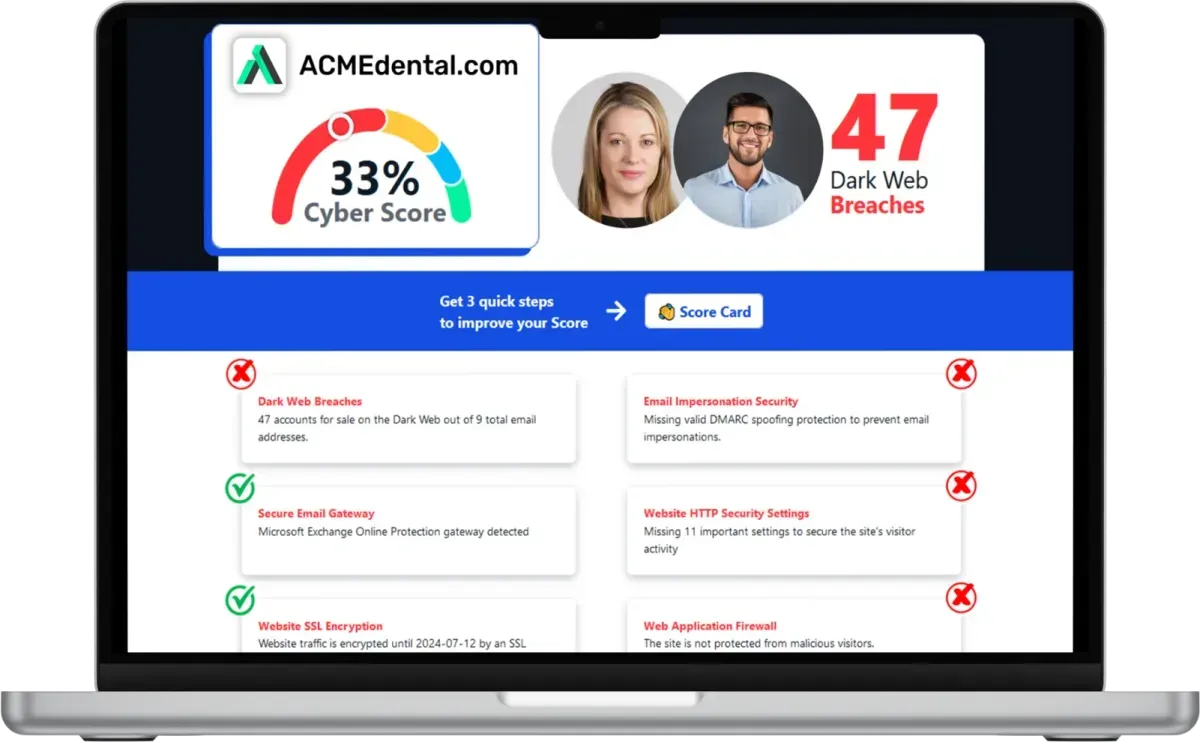
Want to see your Score? Get it in 30 seconds!
What Clients Say About Us
Delivering exceptional customer service is at the heart of our IT management support services. Discover why businesses in Detroit rely on Big Water Tech for dependable IT and computer support.
Excellent Response
They have been our IT support for a number of years and we have always had excellent response for any issues we were having. We currently going through the process of setting us up for more Cyber Security and eliminating the use of a server. They are bringing us up to date with all our computer needs. Their staff is very helpful.

Sharon Pare
Great Experience
We have been using Big Water for managed Services and Support for the past 5-7 years and have had great experience with everything from New Purchase, to Support, to their proactiveness to help us protect our systems. I highly recommend this company for your IT needs.

Alan Borsen
Highly Recommend Their Services
The folks of Big Water are super supportive and helpful. And they thoroughly seem to enjoy find their customers huge savings. Their accurate in their communication and prompt to follow through with any promises. Highly recommend their services.

Korienna Cox
Amazing Company to Work With
Big Water Tech is an amazing company to work with. They are always available to handle any issues or problems that we are having in a timely manner.

Samantha Johnson
Always There
Thanks team! Your Big Water Technologies phone system helps me a lot to serve our customers. I also really appreciate that when I need your help, you are always there!

David Steighner
Solid Team of Professionals
BWT has done such a great job for us, it makes declining solicitor calls from competing companies easy work. BWT has a solid team of professionals that fully address any issue or concern that might arise during the daily course of our business. We are very satisfied with their service and intend to continue our relationship far into the future.

Adam Cowan
Quick to Respond
Big Water Technologies/IT Support Service is a great company! They are quick to respond and to get our questions answered. They are quick to come to our office and accurately do the job we need. If you need a great technology company for all your IT and Phone services - Call Big Water Technologies!

Cathy Bouford
Managing Your Security Has Never Been Simpler

Discover Your Cyber Score
Start by assessing your Cyber Score to understand your business’s online security. This score provides clarity, replacing uncertainty with insight, so you know exactly where you stand and what needs improvement.

Create Your Cyber Roadmap
Use your Cyber Score to develop a clear, actionable Cyber Roadmap. This plan highlights vulnerabilities and provides precise steps to strengthen your security, saving you time and resources. Schedule a meeting with Big Water Tech so we can help you create a clear, strategic path to cyber resilience.

Enhance Your Security
Put your Roadmap into action with a step-by-step approach to stronger protection. Demonstrate your commitment to safeguarding customer data while equipping your IT team with a focused, cost-effective security strategy.
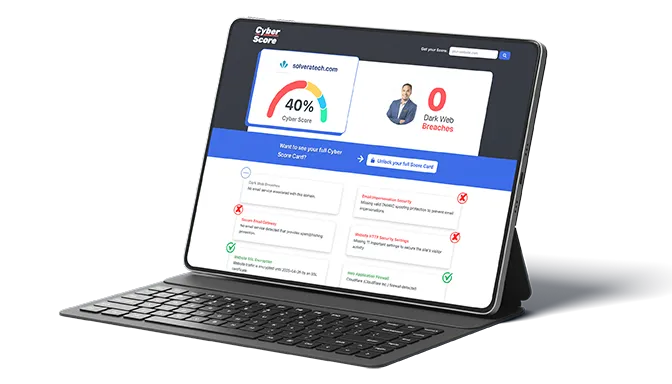
Want to see your Free Cybersecurity Score?
Get it in 30 seconds!
Stay Ahead with Big Water Tech Insights
IT Wisdom Worth Reading for Growing Businesses
Our blog shares practical guidance, expert takes, and real-world lessons drawn from the front lines of IT services & solutions. Stay informed, stay protected, and make smarter decisions for your business or organization.
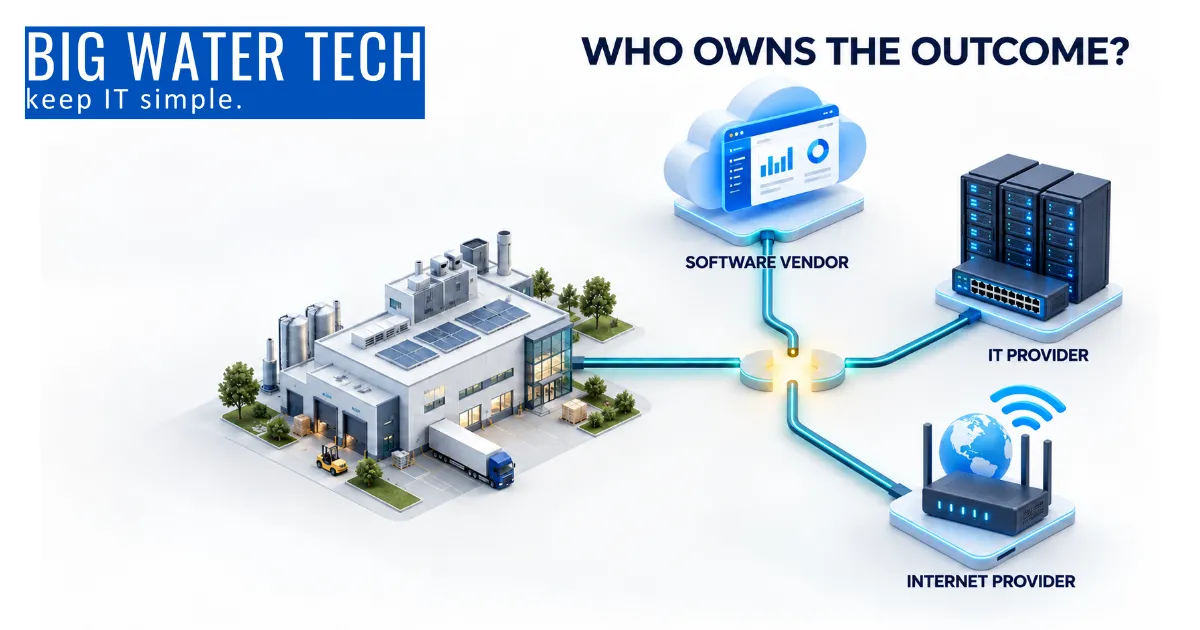
The Most Expensive IT Problem Is the One Everyone Thinks Someone Else Owns
There is a particularly expensive sentence I hear when an important business system stops working:
“We thought they handled that.”
An ERP system slows down, so the software vendor says it is a server problem. The IT provider checks the server and says it is operating normally. The internet provider confirms that the connection is up.
Meanwhile, production is waiting, orders are not shipping, employees cannot work, and the owner has suddenly become the project manager for three technology companies.
The problem is not always that someone failed to do their job. Often, every vendor is doing exactly what their agreement says they are responsible for. The bigger problem is that nobody has accepted responsibility for the outcome.
What does it mean to own a technology outcome?
Owning a technology outcome means someone is responsible for keeping the entire business process working, even when several systems and vendors are involved. That person or provider coordinates troubleshooting, follows up with vendors, communicates with leadership, and stays involved until the business can operate again.
That is different from simply supporting a server, application, firewall, phone system, or internet connection.
Most Michigan businesses do not need one company to provide every piece of technology they use. They do need someone who understands how those pieces work together and who will take the lead when they do not.
Your technology environment was probably built one piece at a time
Most small and midsized businesses did not design their entire technology environment at once. They added pieces as the company grew.
A new phone system was installed here. A line-of-business application was added there. The company moved email to Microsoft 365, adopted a cloud file-sharing platform, purchased a backup solution, and kept a few machines that still depend on an older computer in the corner.
A second internet connection may have been installed several years ago, but nobody has tested whether critical systems will actually use it during an outage.
Every individual piece probably has someone who supports it. However, supporting one piece is not the same as taking responsibility for the business process that depends on all of them.
That difference usually does not become obvious until something stops working.
How unclear IT ownership affects a Michigan manufacturer
Consider a 40-person Michigan manufacturer that relies on its ERP or MRP system to receive orders, schedule production, manage inventory, create shipping documents, and invoice customers.
A single order might pass through:
The company’s internet connection
Its network and servers
The ERP or MRP application
Shop-floor computers or tablets
Production equipment
Shipping software
Customer or supplier portals
The company may have a separate provider supporting each part of that process. When everything is working, that arrangement may seem perfectly reasonable.
When production stops, it can become a different story.
The equipment vendor says the machine is not receiving the correct information from the ERP system. The ERP vendor says its application is running and suggests checking the network. The IT provider says the network is operating normally. Each vendor may be technically correct, but that does not help the plant manager get the next order out the door.
Someone must own the coordination. Someone must collect the evidence, bring the vendors together, communicate with leadership, and stay on the issue until production resumes.
If nobody has that responsibility, the owner, general manager, plant manager, or controller usually inherits it.
That is an expensive use of their time, especially when every hour of delay affects labor, throughput, shipping commitments, and customer relationships.
The same problem exists in professional firms and medical practices
Technology ownership gaps are not limited to manufacturing.
An accounting firm may depend on tax software, document management, Microsoft 365, client portals, scanners, payroll applications, and cloud backup. During tax season, a failure between two of those systems can leave employees unable to access client records or complete returns.
A law firm may have email, practice management software, document storage, court filing systems, timekeeping, billing, and secure client communication platforms. Each system may work independently while an integration failure prevents attorneys and staff from completing the workflow.
A medical practice may rely on its electronic health record system, billing platform, scheduling software, diagnostic equipment, internet service, phones, and cloud applications. When those systems stop communicating, the result may be delayed appointments, inaccessible patient information, billing problems, and frustrated patients.
In each case, the business does not care which vendor’s component is technically working. The business cares whether employees can serve clients, patients, and customers.
Unclear ownership also creates cybersecurity gaps
Technology ownership gaps do more than cause downtime. They can also leave vulnerabilities unresolved.
According to the 2026 Verizon Data Breach Investigations Report, 31% of breaches began with the exploitation of software vulnerabilities. For the first time in the report’s 19-year history, vulnerability exploitation surpassed stolen credentials as the leading initial point of entry.
That does not automatically mean businesses are refusing to install updates. In some cases, the problem is much simpler.
The software vendor assumes the customer or IT provider is responsible for updating the server. The IT provider cannot update the application without the software vendor’s approval. The equipment vendor warns that an operating system update could affect the machine. Everyone waits for someone else to make the decision.
The vulnerability remains open.
This happens frequently with older line-of-business applications, manufacturing equipment, specialty medical systems, accounting software, and other platforms that sit between traditional IT and an outside vendor.
Without documented ownership, important questions go unanswered:
Who monitors the system for newly discovered vulnerabilities?
Who determines whether an update is required?
Who tests whether the update will affect the application or equipment?
Who schedules the work around production, patient care, or client deadlines?
Who verifies that the update was successfully completed?
Who documents the decision if the system cannot be updated?
Cyber insurance applications, customer security questionnaires, HIPAA requirements, IRS Publication 4557, CIS Controls, NIST CSF, and CMMC-related expectations all make those questions more important. “We assumed the vendor handled it” is unlikely to satisfy an insurer, auditor, customer, or regulator after an incident.
Who is responsible when multiple IT vendors are involved?
The responsibility should be documented before an outage or cybersecurity incident occurs.
Your IT provider may not be able to repair proprietary ERP software, reprogram manufacturing equipment, or modify an electronic health record system. However, a Technology Success Partner should still be able to coordinate the response, gather technical information, work with the appropriate vendors, and keep the business informed.
You do not necessarily need one vendor to control everything. You need one clearly identified owner for the outcome.
For most small and midsized businesses, that means establishing:
A list of critical systems and the business processes they support
A primary owner for each system
Clear responsibilities for internal staff, the IT provider, and outside vendors
Documented escalation contacts
Update, backup, and security responsibilities
Recovery procedures if the system cannot be restored quickly
A regular process for testing those procedures
Without that structure, vendor management becomes reactive. The first time everyone discusses responsibility is often while the business is already losing time and money.
Three questions to ask about every critical business system
Start with the systems your business cannot operate without. For each one, ask these three questions.
1. Who owns keeping the system operational?
This is not simply a question of who answers the support line.
Who monitors the system, maintains the underlying technology, coordinates with its vendors, and makes sure smaller issues are addressed before they become larger ones? If the application, server, network, or internet connection fails, who leads the response?
There should be one clear answer, even if several companies participate in the solution.
2. Who owns the updates, backups, and security?
Do not assume the software vendor updates the server. Do not assume your IT provider can safely patch every specialized application. Do not assume information stored in a cloud application is included in your normal backup.
These responsibilities should be documented and periodically verified.
For every critical system, confirm:
Who installs application updates?
Who updates the operating system?
Who monitors for vulnerabilities?
What data is backed up?
How frequently is it backed up?
Who reviews backup failures?
When was the last successful recovery test?
Who manages user access and removes former employees?
Who retains the required documentation?
A backup report showing “successful” is helpful, but it does not prove that the system can be restored within the time your business requires.
3. What happens if the system cannot be fixed quickly?
Every business has a limit to how long it can operate without a critical system. The important question is whether leadership knows what that limit is and has a workable alternative.
Can a manufacturer continue production or shipping manually? Can an accounting firm access the client information needed to meet a filing deadline? Can a law firm retrieve documents before a court appearance? Can a medical practice continue seeing patients and record the necessary information securely?
A business continuity plan does not need to begin as a large binder full of policies. It can begin with practical answers to a few questions:
How long can we operate without this system?
What work can continue?
What work must stop?
What manual process will we use?
Who makes the decision to activate that process?
How will employees communicate if email or phones are unavailable?
When did we last test the plan?
If the alternative process has never been tested, it is still an assumption.
How can a business eliminate gaps between technology vendors?
Begin with a critical systems ownership review.
At your next leadership meeting, identify the three systems that would cause the greatest disruption if they stopped working tomorrow morning. For each system, document the business owner, technical owner, outside vendors, dependencies, backup method, recovery expectations, and escalation process.
Then look for unclear or conflicting answers.
If the software vendor believes your IT provider performs updates, confirm that with the IT provider. If your IT provider believes the cloud vendor backs up your data, verify what the cloud vendor actually retains and whether it can restore what your business needs. If your secondary internet connection is supposed to keep the business operating, test it under realistic conditions.
The objective is not to produce more paperwork. It is to remove assumptions before those assumptions become expensive.
Your IT provider should understand the business outcome
A good technology relationship is not measured only by whether individual devices are online. It is measured by whether the technology supports the way the business operates.
For a manufacturer, that may mean keeping production, inventory, shipping, and customer systems connected across every shift. For an accounting or law firm, it may mean protecting confidential client information while keeping documents and applications available. For a medical practice, it may mean maintaining secure access to patient information, scheduling, billing, and communications.
That requires more than reacting to support tickets. It requires regular business reviews, technology planning, risk discussions, vendor coordination, and a clear understanding of which systems matter most.
At Big Water Technologies, we call that being a Technology Success Partner. Our role is not simply to support individual pieces of technology. It is to help Michigan businesses understand how those pieces support operations, where responsibilities overlap, and what needs to happen when something goes wrong.
Because when an important system goes down, “we thought they handled that” is not much of a recovery plan.
Frequently Asked Questions
What is IT ownership?
IT ownership is the clear assignment of responsibility for maintaining, securing, supporting, and recovering a technology system. It should include both the technical component and the business process that depends on it.
Who should coordinate multiple technology vendors?
A designated internal technology leader or qualified managed IT provider should coordinate the vendors. That coordinator does not need to repair every system personally, but should own communication, troubleshooting, escalation, and follow-through.
Is a software vendor responsible for backups and security updates?
Not necessarily. Some software vendors update only their application and do not maintain the server, operating system, user accounts, or backups. Their responsibilities should be confirmed in writing instead of assumed.
Does Microsoft 365 or another cloud provider automatically back up all business data?
Cloud platforms typically include some retention and recovery capabilities, but these may not meet the company’s recovery, retention, legal, or compliance requirements. Businesses should verify what is protected and consider a separate cloud backup solution.
What systems should be included in a critical technology review?
Include any system whose failure could stop production, delay shipping, prevent employees from serving clients or patients, interrupt billing, expose protected information, or create a contractual or compliance problem.
How often should IT responsibilities be reviewed?
Critical system ownership should be reviewed at least annually and whenever the business adds a new application, changes vendors, opens a location, replaces equipment, or changes an important workflow.
How can Big Water Technologies help?
Big Water Technologies helps small and midsized Michigan businesses identify critical systems, document responsibilities, coordinate vendors, improve cybersecurity, and create practical continuity plans. The goal is to keep technology aligned with the business and eliminate costly gaps before an outage or security incident exposes them.

Our Services
Simple IT Management & Support
BIGview offers proactive management of technology assets on a subscription basis. BIGview is a service based offering designed specifically for your organization's requirements.
Hosted Voice
Desktop & Mobile App, SIP Firewall, and Service Management with flexible VoIP service. Powerful call control on a local business number you can access from anywhere.
Disaster Recovery & Backup
An automated data backup and restore system providing powerful tools to protect your organization's data. It doesn’t require any human assistance beyond the initial installation.
Managed Cloud Environment
Protecting your data is incredibly important. Our BIGcloud Server is highly secure, extremely reliable, easy to scale, and has simple and affordable pricing.

Managed File Sharing
BIGshare Managed Cloud Sharing is a secure, HIPAA & PCI compliant solution. Our BIGshare comes standard with backup and DRaaS all with unlimited storage for one simple price.
Managed Security
BIGprotect is a comprehensive fully-managed security solution. It provides a powerful way to protect your organization’s network .
Voice & Data Protection
BIGguard is a protection plan for your voice and data communications equipment. It provides a powerful way to protect your organization’s voice and data investment.

Security Assessment & Reporting
Elevate your security posture with our assessment and reporting solutions. Gain comprehensive insights into your organization's security landscape.
Frequently Asked Questions
What does an MSP (Managed Services Provider) do?
An MSP proactively monitors, maintains, and secures your IT environment so your business runs smoothly. Big Water Tech handles backups, patching, help desk support, and cloud services, giving you predictable costs, faster response times, and a reliable technology success partner focused on your success across Detroit.
Why choose a local MSP in Southfield and Detroit?
Choosing a local MSP means faster on‑site support, better understanding of regional business needs, and more personalized service. Big Water Technologies is a Southfield‑based Technology Success Partner that serves Detroit, offering managed IT services, cloud solutions, VoIP, and IT consulting that align with your local operations and growth goals.
How does Big Water Technologies’ BIGVoice VoIP phone system work?
Big Water Technologies’ BIGVoice business VoIP phone system uses the internet to deliver voice calls, conferencing, and advanced features across your office and remote teams. It integrates with your existing IT environment, scales with your business, and reduces phone‑line costs while improving reliability and communication tools for your Metro Detroit‑area organization.
How does Big Water Tech approach cybersecurity?
Big Water Tech takes a proactive, layered approach to cybersecurity, combining threat monitoring, endpoint protection, secure backups, and employee training. We assess your unique risks, implement tailored defenses, and continuously update your security posture to protect data, systems, and compliance across your Detroit organization.
What are the benefits of outsourcing IT support and services?
Outsourcing IT support gives you access to expert resources without the overhead of an in‑house team. With Big Water Tech, you gain faster response times, reliable help desk support, scalable cloud solutions, and stronger cybersecurity, so your Detroit business stays agile, secure, and focused on growth.
Take IT Off Your Plate...
Spend less time on IT problems and more time growing your business. Let’s get to know each other and determine how our partnership could grow. With us as your trusted MSP on your side, you can develop a strong barrier against cybercrime, stronger communication strategies, and a better technology plan for the future.
Call (248) 220-7714 today or fill out the form below to schedule your appointment. We’re ready to jumpstart your IT journey.

Looking to Switch?
© Copyright 2026 Big Water Tech. All Rights Reserved. Built in partnership with Tech Pro Marketing | Privacy Policy | Client Portal | Areas We Serve


