
Detroit's Trusted & Reliable IT Support Provider
For Small & Mid-Size Businesses
As a trusted MSP serving Southfield, Detroit, and the surrounding areas, Big Water Tech delivers expert business Outsourced IT Support, proactive cybersecurity, 24/7 help desk, and seamless BIGVoice VoIP phone systems. We take IT off your plate so you can focus on growing your business with confidence and peace of mind.


Schedule a Call
Schedule a 30-minute call to see if we are a good fit to help your business.

Your Neighborhood Technology Success partner

Tress Saunders
Client Success Coordinator

Jennifer Shubow
Senior Sales Executive

Beverly Ames
Carrier Services Manager

Lisa Sariol
Manager of Operations

Robert Shubow
President

John Lowery
CEO

Marc Landau
IT Director

Bill Hickey
Client Services Manager

Glen Adams
Project Coordinator
Why Detroit Businesses Choose Big Water Technologies
Comprehensive IT Solutions
Big Water Technologies offers tailored business IT support solutions covering managed services, business phone systems, cybersecurity, cloud services, and more.
Security and Compliance Experts
You can rest assured knowing we're security and IT compliance experts. We are a Cyber AB Registered Practitioner for CMMC, helping Detroit businesses and government contractors meet federal cybersecurity requirements.
Exceptional Customer Service
Our team has been in the industry since the 1970s - allowing us to offer you informed, strategic insight while maintaining a high level of customer service.
Commitment to Client Success
You're far too busy to worry about technology and tech problems. That's why your success is our success. We make IT work for you - so you can drive growth, productivity, and have peace of mind.
Client Success Stories

We currently use Big Water for our managed phone service and they are great! We have had issue with managed phone service providers in the past but Jenn is super responsive when we have an issue or need a new line added or removed. I would not hesitate to recommend Big Water for managed phone services, low voltage or other technology needs!
COLLEEN BUDDE
Franchise Owner at Office Evolution Troy
Our Clients Say It Best
We’re proud to earn top marks from our clients through Crewhu’s customer feedback program. Every response helps us improve - and confirms that our team is making a real difference through responsive, friendly, and effective IT support. When our clients succeed, we succeed - and that’s what drives everything we do.
Is Your Technology Getting in the Way of Running Your Business?
You’re not alone, and it doesn’t have to be this complicated.

John Lowery
CEO, Big Water Tech
Big Water Tech is Here to Help Keep IT Simple with Our Reliable IT Support.
At BigWater Technologies, safeguarding the integrity and security of your IT system is non-negotiable. We're dedicated to optimizing your technology to enhance efficiency and power.
Feel like you’ve been down this road before?
If you've felt burned by managed services providers in the past, rest assured, we prioritize fostering lasting client relationships over maximizing profits. Our focus is on maximizing the potential of your current IT infrastructure while keeping costs in check – possibly even reducing them.
Contact us at (248) 220-7714 to kick-start crucial IT discussions tailored to businesses like yours. Let's redefine your IT experience together.
Schedule an Appointment Today
As Your Technology Success Partner,
We're Here to Help You Drive Growth With Our Services:

Simplified IT Management
BIGview offers proactive corporate IT support and IT management services of technology assets on a subscription basis.

VoIP & Hybrid Phone Systems
Desktop & Mobile App, as well as Service Management with flexible VoIP service.

Vendor Neutral Management
We provide a thorough needs assessment, available provider review, order management, issue management, and regular bill reviews.

Comprehensive Equipment Support
We take care of your network security, switching, WiFi, servers, computers, video conferencing, and more.

Installation & Support
Low voltage cabling, paging, and camera systems designed to fit the needs of your team.

Ongoing Evaluation and Planning
Stay focused on the success of your company with regular proactive business reviews.

Protect Your Business from Cyber Threats
Proactive monitoring, threat detection, and compliance-focused security solutions that safeguard your systems, data, and operations around the clock. Our BIGshare solution is HIPAA and PCI compliant, built for healthcare, legal, and financial services businesses.

Responsive User Assistance
Fast, reliable technical support that resolves user issues, reduces downtime, and keeps your team productive.

Empower Work, Anywhere, Anytime
Streamline collaboration, enhance productivity, and secure your business with expert Microsoft 365 setup, management, and ongoing support.

Scale Smarter, Operate Anywhere
Optimize performance, enhance flexibility, and reduce costs with secure, scalable cloud solutions tailored to your business needs.
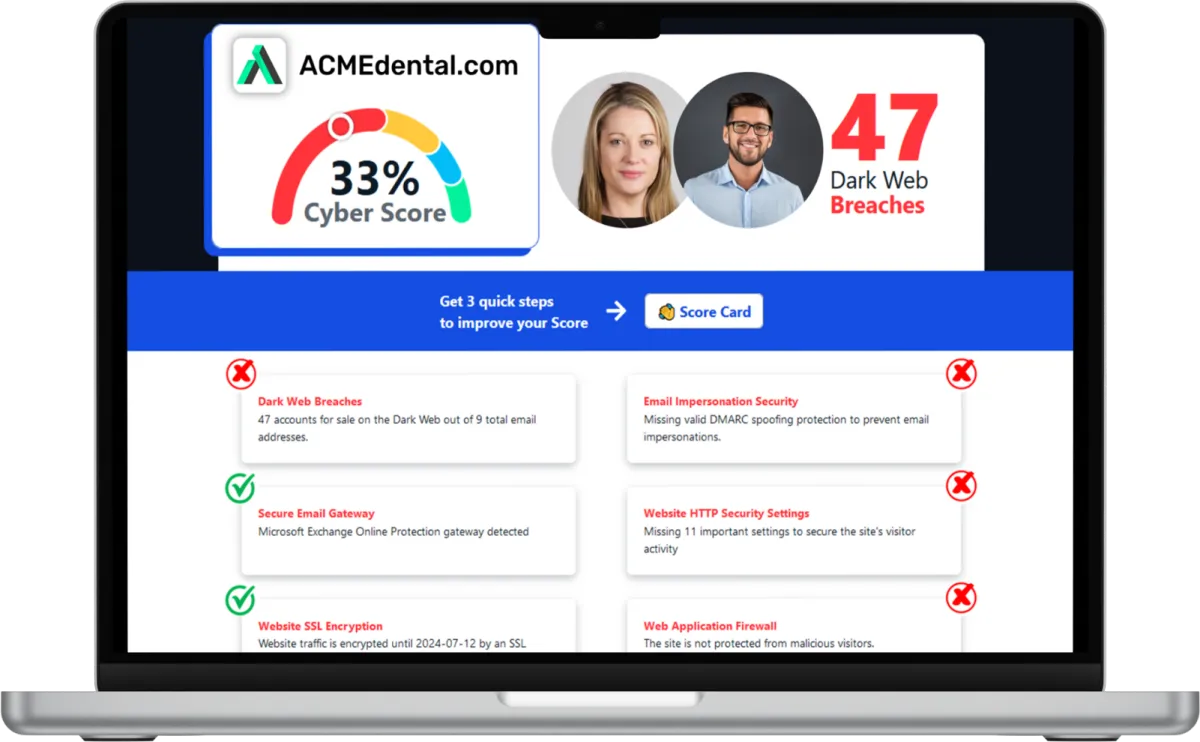
Want to see your Score? Get it in 30 seconds!
What Clients Say About Us
Delivering exceptional customer service is at the heart of our IT management support services. Discover why businesses in Detroit rely on Big Water Tech for dependable IT and computer support.
Excellent Response
They have been our IT support for a number of years and we have always had excellent response for any issues we were having. We currently going through the process of setting us up for more Cyber Security and eliminating the use of a server. They are bringing us up to date with all our computer needs. Their staff is very helpful.

Sharon Pare
Great Experience
We have been using Big Water for managed Services and Support for the past 5-7 years and have had great experience with everything from New Purchase, to Support, to their proactiveness to help us protect our systems. I highly recommend this company for your IT needs.

Alan Borsen
Highly Recommend Their Services
The folks of Big Water are super supportive and helpful. And they thoroughly seem to enjoy find their customers huge savings. Their accurate in their communication and prompt to follow through with any promises. Highly recommend their services.

Korienna Cox
Amazing Company to Work With
Big Water Tech is an amazing company to work with. They are always available to handle any issues or problems that we are having in a timely manner.

Samantha Johnson
Always There
Thanks team! Your Big Water Technologies phone system helps me a lot to serve our customers. I also really appreciate that when I need your help, you are always there!

David Steighner
Solid Team of Professionals
BWT has done such a great job for us, it makes declining solicitor calls from competing companies easy work. BWT has a solid team of professionals that fully address any issue or concern that might arise during the daily course of our business. We are very satisfied with their service and intend to continue our relationship far into the future.

Adam Cowan
Quick to Respond
Big Water Technologies/IT Support Service is a great company! They are quick to respond and to get our questions answered. They are quick to come to our office and accurately do the job we need. If you need a great technology company for all your IT and Phone services - Call Big Water Technologies!

Cathy Bouford
Managing Your Security Has Never Been Simpler

Discover Your Cyber Score
Start by assessing your Cyber Score to understand your business’s online security. This score provides clarity, replacing uncertainty with insight, so you know exactly where you stand and what needs improvement.

Create Your Cyber Roadmap
Use your Cyber Score to develop a clear, actionable Cyber Roadmap. This plan highlights vulnerabilities and provides precise steps to strengthen your security, saving you time and resources. Schedule a meeting with Big Water Tech so we can help you create a clear, strategic path to cyber resilience.

Enhance Your Security
Put your Roadmap into action with a step-by-step approach to stronger protection. Demonstrate your commitment to safeguarding customer data while equipping your IT team with a focused, cost-effective security strategy.
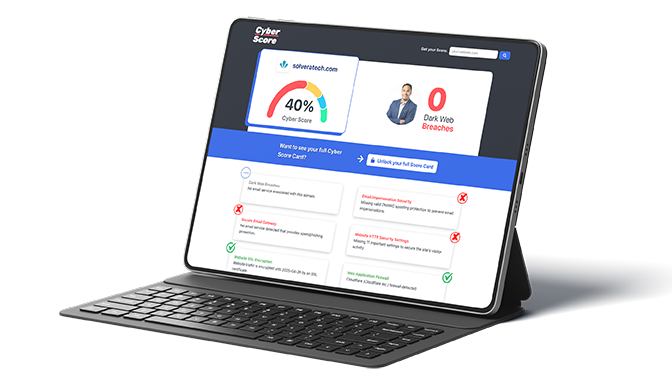
Want to see your Free Cybersecurity Score?
Get it in 30 seconds!
Stay Ahead with Big Water Tech Insights
IT Wisdom Worth Reading for Growing Businesses
Our blog shares practical guidance, expert takes, and real-world lessons drawn from the front lines of IT services & solutions. Stay informed, stay protected, and make smarter decisions for your business or organization.
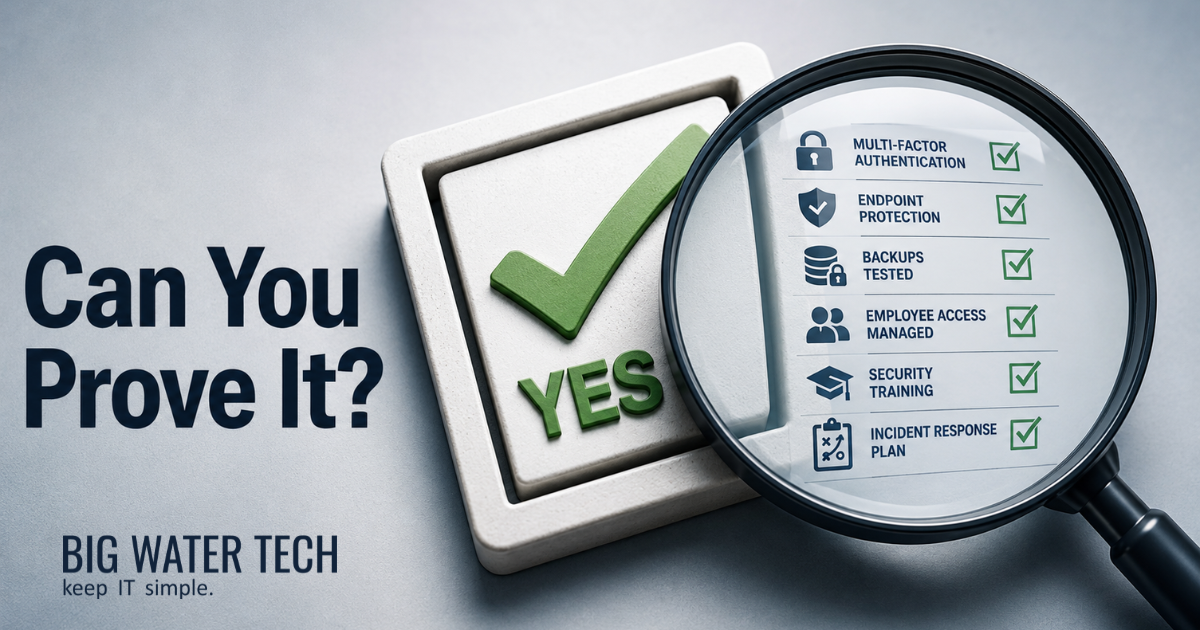
Your Cyber Insurance Application Is Becoming a Security Audit
Cyber insurance applications have changed quite a bit over the last few years. What used to be a relatively straightforward insurance questionnaire has turned into something much closer to a cybersecurity assessment. Insurers want to know about multifactor authentication, backups, endpoint security, employee access, security awareness training, incident response, remote access, cloud applications, and a growing list of other controls.
For small and midsize businesses, especially accounting firms, law firms, and medical practices, there's an important shift happening here. Your cyber insurance application isn't just insurance paperwork anymore. It's becoming a security audit, and the most important question isn't whether you can check "Yes" on the application. It's whether you can prove why the answer is yes.
What Is Cyber Insurance Readiness?
Cyber insurance readiness means having the cybersecurity controls, processes, and documentation needed to accurately answer the questions on a cyber insurance application.
That's different from simply having cyber insurance.
A business can have a policy and still have gaps between what management believes is happening and what is actually happening across its technology environment. Cyber insurance readiness is about finding those gaps before the renewal, and preferably before an incident.
For an owner or manager, I think the easiest way to look at it is this: if your insurance company asks whether you have a particular security control, can you confidently answer the question and produce evidence supporting that answer?
If not, that's something worth investigating.
What Is a Cyber Insurance Security Assessment?
A cyber insurance security assessment compares the cybersecurity statements made on your insurance application with the controls actually operating inside your business.
If the application asks whether you use multifactor authentication, for example, knowing that your company has MFA isn't necessarily enough. You need to understand where it's required, which users are covered, whether important systems are protected, and whether there are exceptions you don't know about.
The same principle applies to backups, endpoint protection, employee access, security awareness training, incident response, and other controls.
This distinction matters because having a cybersecurity product and consistently operating a cybersecurity control are not the same thing. You can own the technology without having the process behind it.
Why Are Cyber Insurance Applications Getting More Detailed?
Cyber insurance applications are becoming more detailed because insurers need a better understanding of the cybersecurity risk they're being asked to insure.
That means the questions are increasingly focused on specific security practices rather than general statements about whether a company "has cybersecurity."
Depending on the insurer, business, and policy, questions may address multifactor authentication, endpoint protection, email security, backup and recovery, employee security training, administrative access, vulnerability management, incident response, remote access, cloud applications, third-party access, and data protection.
As a business owner, you don't need to understand every technical detail behind those controls. You do need to know whether your organization is actually doing what the application says it is doing.
That's the management issue hiding inside what looks like a technical questionnaire.
What Cybersecurity Controls Do Cyber Insurance Companies Look For?
The exact requirements vary by insurer and policy, but businesses should be prepared to answer detailed questions about how they protect accounts, devices, data, employees, and critical business systems.
Some of the areas commonly addressed include:
Multifactor authentication
Endpoint security
Email security
Backup and recovery
Security awareness training
Employee onboarding and offboarding
Administrative privileges
Remote access
Vulnerability management
Incident response
Cloud application security
Third-party and vendor access
The important point isn't memorizing a list. It's understanding that the insurance company may expect more than simply having these technologies somewhere in your environment.
If you're answering yes, understand what you're saying yes to.
Does Cyber Insurance Require Multifactor Authentication?
Many cyber insurance applications ask detailed questions about multifactor authentication, although the exact requirements depend on the insurer and policy.
MFA is a good example of why these applications can be harder to answer than they first appear.
Suppose the application asks whether your organization requires MFA. Someone asks the IT provider, the answer comes back yes, you check the box, and everybody moves on.
But what exactly does "yes" mean?
Maybe MFA protects Microsoft 365, but what about remote access, administrator accounts, payroll, HR, banking, accounting software, your practice management system, or other important cloud applications? What if a department added another application six months after the insurance renewal and nobody thought about whether MFA was required there?
There's a big difference between saying, "We use MFA," and knowing, "We have verified that MFA is being enforced where our insurance application says it is."
That second answer is where I want our clients to be.
How Often Should You Review Your Cyber Insurance Security Controls?
Businesses should review the cybersecurity controls behind their insurance application throughout the year, not only when the policy renews.
I think this is one of the biggest weaknesses in the traditional cyber insurance process. The application is completed at a specific point in time, but your business keeps changing for the next twelve months.
During that year you may hire employees, lose employees, add remote workers, replace computers, open another location, change vendors, or adopt new software. An accounting firm might change tax or document management software. A law firm might add a new client portal. A medical practice might connect another service to its existing systems.
And now we have AI.
Employees are adopting AI tools faster than almost any business technology I've seen in my 30-plus years in IT. Some of those tools can connect to email, documents, cloud storage, client information, and other business systems.
Every one of those changes has the potential to affect the cybersecurity environment you described on your insurance application. That's why cyber insurance readiness should become something you manage during the year rather than something you scramble to deal with once a year.
Can Employee Turnover Affect Cyber Insurance Readiness?
Yes. Employee turnover can create cybersecurity and cyber insurance issues when accounts, applications, permissions, or third-party access aren't consistently removed after someone leaves.
When someone is hired, there's urgency around getting them what they need. They need email, applications, files, cloud services, and possibly remote access. If they can't work on Monday morning, everyone notices.
Offboarding doesn't have the same built-in urgency.
When somebody leaves, nobody immediately notices that an old account, cloud application, or third-party login is still active. The former employee may also have connected AI tools, file-sharing services, or other applications that aren't part of the company's normal offboarding checklist.
If your cyber insurance application asks about employee access controls or offboarding, having a written procedure is certainly better than having nothing. But the more useful question is whether you can verify that the procedure is consistently followed.
A process that exists on paper and a process that happens every time are two different things.
Are Backups Enough for Cyber Insurance?
Simply having backups may not be enough to demonstrate good backup and recovery practices. Businesses should understand what is backed up, how backups are protected, and whether data and systems can actually be recovered.
Almost every established business I talk to has some form of backup. The questions I care more about are what is being backed up, how frequently it's happening, where those backups are stored, whether they're protected from the same incident that could affect the production systems, and when somebody last tested an actual recovery.
I've been doing this for more than 30 years, and there is a major difference between seeing a dashboard that says "Backup Successful" and knowing you can recover the business when you need to.
If you suffer a ransomware attack, hardware failure, accidental deletion, or another major incident, nobody is going to care how reassuring the backup report looked the week before. They're going to care whether you can get the business running again.
So if your cyber insurance application asks whether you maintain backups, don't stop at "Yes." Understand what that yes actually represents.
Does Cyber Insurance Require Security Awareness Training?
Many cyber insurance applications ask whether employees receive cybersecurity or security awareness training. The exact training requirements vary by insurer and policy.
The question looks simple until you start asking what actually happens inside the company. Maybe employees receive cybersecurity training when they're hired or once a year. That's a good start, but is everyone completing it? Is completion tracked? What happens when somebody doesn't finish? Are phishing simulations being performed? Can you produce records showing what was done?
The point isn't to turn a business owner into a cybersecurity auditor. It's to recognize the difference between saying something happens and being able to demonstrate that it happens.
We're seeing that distinction show up in more places than cyber insurance. Client security questionnaires, compliance requirements, vendor assessments, and insurance applications are increasingly asking different versions of the same questions.
Who Should Complete a Cyber Insurance Application?
A cyber insurance application should usually involve business leadership, the organization's IT or cybersecurity provider, and the insurance professional rather than being completed by one person working alone.
This is where I see a management problem with a lot of organizations.
The application lands in someone's inbox. The owner doesn't understand some of the terminology, so it gets forwarded to the IT person or IT provider. IT answers the technical questions, the insurance agent handles the insurance portion, HR may answer questions about employees, and someone else may be responsible for compliance.
Eventually everything gets assembled and somebody signs it.
But who owns the accuracy of the entire application?
I've worked with small and midsize businesses for more than 30 years, and one thing hasn't changed: when responsibility is spread across five people, it can very quickly become nobody's responsibility.
The owner assumes IT has security covered. IT assumes HR handles employee procedures. HR assumes managers notify IT when somebody leaves. The insurance agent assumes the company has verified its answers.
Everyone can do their individual job correctly while nobody looks at the complete picture.
That's why I don't believe a cyber insurance application should simply be handed to "the IT person." IT absolutely needs to be involved, but this is ultimately a business risk conversation. Someone in leadership needs to own it.
What Happens If Information on a Cyber Insurance Application Is Wrong?
The consequences of inaccurate information on a cyber insurance application depend on the policy, application language, circumstances, applicable law, and other factors. Businesses should discuss questions about insurance coverage and application representations with their insurance professional and, when appropriate, legal counsel.
From the technology and risk side, my advice is much simpler: don't guess and don't assume.
If you aren't sure whether a security control is actually in place, verify it before answering the question. If the answer isn't what you hoped it would be, that's useful information because now you know what needs attention.
I'd much rather discover that during a review than after an incident.
What Should You Do Before a Cyber Insurance Renewal?
Before a cyber insurance renewal, businesses should validate the security controls referenced in the application, review what has changed since the previous application, and gather documentation supporting their answers.
Start with multifactor authentication and make sure you understand which systems and users are actually protected. Look at backups and, more importantly, whether you know you can recover from them. Review former employees and vendors to make sure access was removed properly. Confirm that computers and servers have the security, monitoring, and management you believe they have.
Then look beyond the technology. Are employees completing cybersecurity training? Do you know which cloud and AI applications are being used? Does your incident response plan tell people who makes decisions and who needs to be contacted? Can you produce documentation supporting the answers you're giving?
And look at what has changed since your last renewal. New employees, vendors, locations, applications, cloud services, remote access, and AI tools can all change the environment you originally described.
Evidence beats assumptions.
Why Should You Review Cyber Insurance Requirements Throughout the Year?
Reviewing cyber insurance controls throughout the year helps a business identify security drift before the next renewal or, more importantly, before a cyber incident.
You don't need to turn this into another enormous administrative project. Take out your current cyber insurance application a few times during the year and use the important questions as a management check.
If you said you use MFA, verify it. If you said you have backups, verify that recovery works. If you said employees receive security training, review completion. If you said accounts are disabled when employees leave, audit a few former employees. If you said you have an incident response plan, make sure the people named in it know what they're supposed to do.
For most small and midsize organizations, a consistent review process is far more valuable than creating a complicated security program that nobody has time to maintain.
How Are Cyber Insurance and Compliance Connected?
Cyber insurance and compliance are separate issues, but they increasingly ask businesses to demonstrate many of the same underlying cybersecurity practices.
Your cyber insurance company asks whether you use MFA. Then a large client sends a security questionnaire asking essentially the same thing. A compliance requirement addresses access controls. A vendor assessment wants to know how accounts are protected.
Different documents, same underlying business issue.
We're seeing similar overlap around backups, employee access, security awareness, endpoint protection, incident response, vulnerability management, and data protection.
For accounting firms, law firms, and medical practices, this matters because you're protecting sensitive information that belongs to other people. Depending on the firm, that may include financial information, tax records, legal documents, confidential communications, personally identifiable information, or protected health information.
That's why building cybersecurity controls just to satisfy an insurance questionnaire is the wrong goal.
Build a reasonable security program for the business. When you do that, insurance, compliance, and client security questions become much easier to answer because the underlying work is already being done.
Can an IT Provider Help With a Cyber Insurance Application?
Yes. An experienced IT or cybersecurity provider can help a business understand and verify the technology controls referenced in a cyber insurance application, but the provider shouldn't make insurance or coverage decisions for the business.
That's an important line.
Your insurance professional should explain what the insurer is asking and what your policy requires. Your IT provider should be able to tell you whether the underlying technology control exists, how it's configured, and whether the answer can be supported.
If the application asks about MFA, we should be able to help you determine where MFA is deployed.
If it asks about endpoint security, we should understand what's protecting your computers.
If it asks about backups, we should know what is protected and how recovery works.
If it asks about vulnerability management, access controls, email security, or other technical controls, your IT provider shouldn't be guessing.
That's where having good documentation becomes extremely valuable.
What Is the Difference Between Cyber Insurance Readiness and Cybersecurity?
Cybersecurity is the broader process of protecting the organization's systems, accounts, data, and operations. Cyber insurance readiness focuses on understanding and validating the controls relevant to obtaining and maintaining appropriate cyber insurance coverage.
The two should support each other.
I don't recommend building a cybersecurity program around an insurance questionnaire. An insurer's application is only one view of your risk, and different carriers may ask different questions.
But the application can be a useful management tool.
Insurance companies spend a lot of time studying losses. When they repeatedly ask about certain cybersecurity controls, it's worth paying attention.
If a question makes you uncomfortable because nobody knows the answer, that's useful. If IT and management give different answers, that's useful too. If you discover that a control was implemented three years ago and nobody has checked it since, you just found something worth fixing.
The goal isn't to pass the questionnaire. The goal is to find problems while they're still inexpensive problems.
Cyber Insurance Readiness for Michigan Accounting, Law, and Medical Firms
For Michigan accounting firms, law firms, medical practices, and other professional service businesses, cyber insurance readiness is becoming part of normal business risk management.
Clients care about cybersecurity. Insurance companies care about it. Regulators care about it. Larger organizations increasingly want to understand how their vendors and professional service providers protect sensitive information before they'll do business with them.
You don't need to become a cybersecurity expert to manage that responsibility. You do need a way to know that the controls your business says it has are actually in place and working.
At Big Water Technologies, we work with small and midsize businesses across Michigan to understand their technology environments, identify security gaps, and put practical controls around the systems their businesses depend on.
That includes helping clients understand the technology questions appearing on cyber insurance applications and determining where an answer needs to be verified rather than assumed.
We aren't your insurance agent, and we don't determine what your policy requires. Your insurance professional should guide you on the policy itself. Our job is to help you understand whether the technology and security controls behind those answers are actually there.
Because ultimately, the most important cyber insurance question isn't whether you can check "Yes."
It's whether you can prove it.
Cyber Insurance Readiness FAQs
What is cyber insurance readiness?
Cyber insurance readiness is the process of making sure your business has the cybersecurity controls, processes, and documentation necessary to accurately answer a cyber insurance application and support those answers.
What cybersecurity controls do cyber insurers ask about?
Requirements vary, but cyber insurance applications may ask about multifactor authentication, endpoint protection, email security, backups, security awareness training, employee access, administrative privileges, vulnerability management, remote access, incident response, and other security controls.
Does my business need MFA for cyber insurance?
Many cyber insurance applications ask about multifactor authentication, but specific requirements vary by carrier and policy. Businesses should confirm their insurer's requirements and verify where MFA is actually enforced before answering.
Does cyber insurance require backups?
Cyber insurance applications commonly include questions about backup and recovery practices. Businesses should understand not only whether backups exist but what is protected, how backups are secured, and whether recovery has been tested.
Who should fill out a cyber insurance application?
Business leadership, the IT or cybersecurity provider, and the insurance professional should generally collaborate. Technical answers should be verified by people who understand the actual environment, while policy and coverage questions should be handled by the insurance professional.
Should my IT company complete my cyber insurance application for me?
Your IT provider can help verify technical information, but business leadership should retain ownership of the application. Your insurance professional should provide guidance regarding insurance requirements and coverage.
How often should we review our cyber insurance security controls?
At minimum, controls should be validated as part of the renewal process. I also recommend reviewing important controls during the year and whenever there are significant changes involving employees, systems, vendors, locations, cloud services, or AI tools.
How can we prepare for a cyber insurance renewal?
Start before the application arrives. Review your previous answers, identify what's changed, validate important security controls, test recovery procedures, review employee access, confirm security training, and collect documentation supporting your answers.
Can AI use affect cyber insurance risk?
AI can change a company's technology and data environment when employees connect AI applications to company accounts, documents, email, cloud storage, or sensitive information. Businesses should include AI applications in their broader software, access, data protection, and vendor-risk processes.
Can Big Water Technologies help with cyber insurance readiness?
Big Water Technologies can help Michigan businesses understand and verify the technology and cybersecurity controls behind questions appearing on cyber insurance applications. We help identify gaps, document the technology environment, and determine what needs attention before an organization makes assumptions about its security posture.
If you're approaching a cyber insurance renewal and aren't completely comfortable with some of the technology or security questions, talk to Big Water Technologies before you guess.
We'll help you understand what you have, what you don't, and what deserves attention.
Keep IT Simple.

Our Services
Simple IT Management & Support
BIGview offers proactive management of technology assets on a subscription basis. BIGview is a service based offering designed specifically for your organization's requirements.
Hosted Voice
Desktop & Mobile App, SIP Firewall, and Service Management with flexible VoIP service. Powerful call control on a local business number you can access from anywhere.
Disaster Recovery & Backup
An automated data backup and restore system providing powerful tools to protect your organization's data. It doesn’t require any human assistance beyond the initial installation.
Managed Cloud Environment
Protecting your data is incredibly important. Our BIGcloud Server is highly secure, extremely reliable, easy to scale, and has simple and affordable pricing.

Managed File Sharing
BIGshare Managed Cloud Sharing is a secure, HIPAA & PCI compliant solution. Our BIGshare comes standard with backup and DRaaS all with unlimited storage for one simple price.
Managed Security
BIGprotect is a comprehensive fully-managed security solution. It provides a powerful way to protect your organization’s network .
Voice & Data Protection
BIGguard is a protection plan for your voice and data communications equipment. It provides a powerful way to protect your organization’s voice and data investment.

Security Assessment & Reporting
Elevate your security posture with our assessment and reporting solutions. Gain comprehensive insights into your organization's security landscape.
Frequently Asked Questions
What does an MSP (Managed Services Provider) do?
An MSP proactively monitors, maintains, and secures your IT environment so your business runs smoothly. Big Water Tech handles backups, patching, help desk support, and cloud services, giving you predictable costs, faster response times, and a reliable technology success partner focused on your success across Detroit.
Why choose a local MSP in Southfield and Detroit?
Choosing a local MSP means faster on‑site support, better understanding of regional business needs, and more personalized service. Big Water Technologies is a Southfield‑based Technology Success Partner that serves Detroit, offering managed IT services, cloud solutions, VoIP, and IT consulting that align with your local operations and growth goals.
How does Big Water Technologies’ BIGVoice VoIP phone system work?
Big Water Technologies’ BIGVoice business VoIP phone system uses the internet to deliver voice calls, conferencing, and advanced features across your office and remote teams. It integrates with your existing IT environment, scales with your business, and reduces phone‑line costs while improving reliability and communication tools for your Metro Detroit‑area organization.
How does Big Water Tech approach cybersecurity?
Big Water Tech takes a proactive, layered approach to cybersecurity, combining threat monitoring, endpoint protection, secure backups, and employee training. We assess your unique risks, implement tailored defenses, and continuously update your security posture to protect data, systems, and compliance across your Detroit organization.
What are the benefits of outsourcing IT support and services?
Outsourcing IT support gives you access to expert resources without the overhead of an in‑house team. With Big Water Tech, you gain faster response times, reliable help desk support, scalable cloud solutions, and stronger cybersecurity, so your Detroit business stays agile, secure, and focused on growth.
Take IT Off Your Plate...
Spend less time on IT problems and more time growing your business. Let’s get to know each other and determine how our partnership could grow. With us as your trusted MSP on your side, you can develop a strong barrier against cybercrime, stronger communication strategies, and a better technology plan for the future.
Call (248) 220-7714 today or fill out the form below to schedule your appointment. We’re ready to jumpstart your IT journey.
Looking to Switch?
© Copyright 2026 Big Water Tech. All Rights Reserved. Built in partnership with Tech Pro Marketing | Privacy Policy | Client Portal | Areas We Serve


