
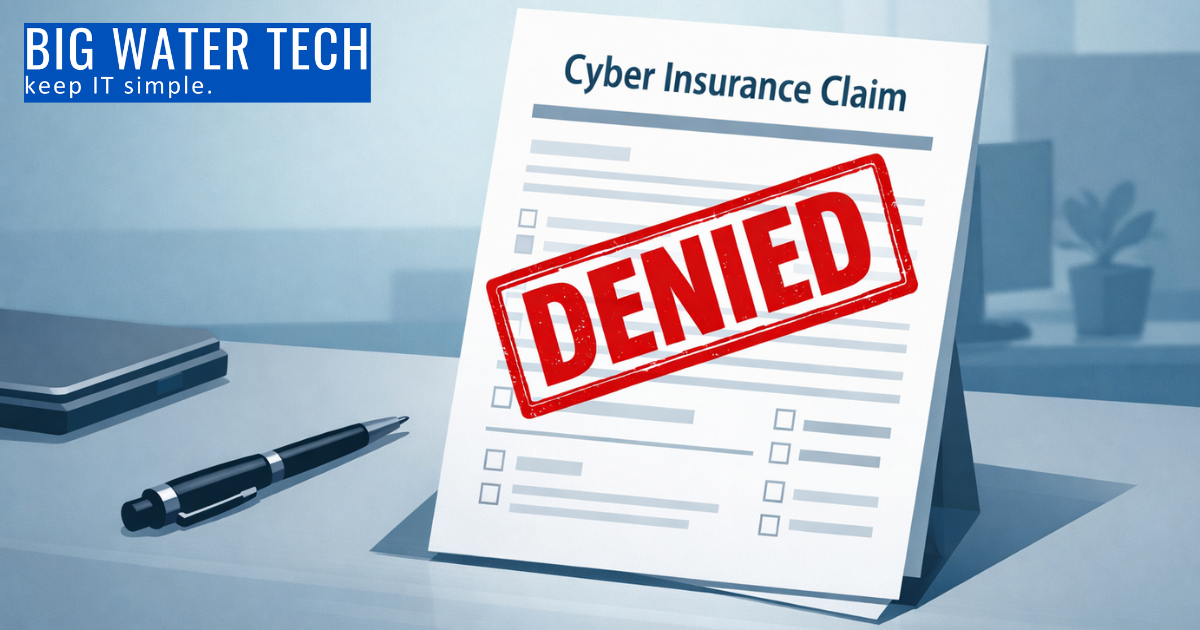
Why Cyber Insurance Isn't a Security Strategy
What small businesses need to know about cyber liability coverage, claim denials, and the gap between having a policy and being protected
What is cyber insurance, and what does it actually cover?
Cyber insurance (also called cyber liability insurance) is a policy designed to help businesses recover financially after a cyber incident, things like data breaches, ransomware attacks, business interruption, and legal liability.
But here's what many business owners don't realize: cyber insurance doesn't prevent attacks, and it doesn't guarantee payouts.
Most policies come with requirements. If you can't prove you met those requirements when you filed your application, your claim can be denied even if you've been paying premiums for years.
Why do businesses think cyber insurance is enough?
Cyber insurance has become a checkbox for many small and mid-sized businesses. They buy the policy, file it away, and assume they're covered if something happens.
The problem: the policy becomes an excuse not to invest in actual security controls.
Common assumptions that get firms in trouble:
"We have insurance, so we're covered if we get hit with ransomware."
"The policy will pay for everything, data recovery, legal fees, business interruption."
"We answered yes on the application, so we must have the controls in place."
These assumptions often don't survive contact with a real claim.
What are the most common cyber insurance requirements?
Most cyber insurance policies require businesses to have specific security controls in place. Common requirements include:
Multi-factor authentication (MFA) on all user accounts and remote access
Regular, tested backups with documented recovery procedures
Endpoint detection and response (EDR) on all devices
A written incident response plan
Security awareness training for employees
Access logging and monitoring
If you attested to having these controls on your application but can't prove they're actually in place, you're at risk of a denied claim.
Can a cyber insurance claim be denied? What causes claim denials?
Yes. Cyber insurance claims are denied more often than most business owners realize.
The most common reason for denial: material misrepresentation.
This means you said something on your application that wasn't accurate, either intentionally or because you didn't verify before answering.
Examples that lead to denied claims:
Attesting to MFA on all accounts when it was only enabled on some
Claiming backups are tested regularly when they haven't been verified in months
Saying you have an incident response plan when it's never been documented or practiced
Answering "yes" to security controls that exist on paper but aren't enforced
Carriers aren't just asking questions anymore, they're verifying answers. If your attestation doesn't match reality, your claim is at risk.
What does "material misrepresentation" mean in cyber insurance?
Material misrepresentation is when a business provides inaccurate information on an insurance application that affects the insurer's decision to provide coverage or set premiums.
In cyber insurance, this often happens when:
The person filling out the application doesn't actually know the current state of security controls
The IT person says "yes" to questions because that's what they've always said
Nobody verifies whether attested controls are actually in place and working
The result: When a claim is filed, the carrier investigates. If they find gaps between what was attested and what's actually in place, they can deny the claim based on material misrepresentation.
The policy exists. You paid the premium. But it won't pay out.
What's the difference between having cyber insurance and being protected?
Having cyber insurance means you have a financial backstop if something goes wrong.
Being protected means you have the controls, processes, and documentation in place to:
Reduce the likelihood of an incident
Respond effectively if one occurs
Prove to your carrier that you met your policy requirements
Cyber insurance is part of a security strategy. It's not the strategy itself.
Firms that treat insurance as a substitute for security often find out too late that the policy won't cover them when they need it most.
How can businesses make sure their cyber insurance will actually pay out?
Here's how to close the gap between having a policy and being protected:
1. Read your policy. Actually read it
Know what's covered, what's excluded, and what requirements you agreed to meet. If you can't explain your coverage in plain English, you don't understand it well enough.
2. Review your application
Pull out the application you signed. Look at every question you answered "yes" to. Can you prove each one with documentation? If the answer is "I'd have to check with IT," that's a red flag.
3. Verify your controls
Don't assume controls are in place because someone said they were. Test your backups. Confirm MFA is enabled everywhere. Review your incident response plan. Document everything.
4. Close gaps before renewal
If there's a gap between what you attested to and what's actually in place, fix it now not after an incident, not at renewal time.
5. Separate attestation from implementation
The person filling out the questionnaire shouldn't be the same person who set up the controls. Get outside verification of your security posture before you sign.
What should small businesses do before their next cyber insurance renewal?
Before your next renewal, ask yourself:
When was the last time we actually read our policy?
Can we document every control we attested to on the application?
Have we tested our backups in the last 90 days?
Is MFA enabled on all accounts, not just some?
Do we have a written incident response plan that's been reviewed this year?
Who's verifying that our controls actually work?
If you can't answer these questions confidently, you have work to do before renewal.
The Bottom Line
Cyber insurance is a financial tool, not a security strategy.
The businesses that get value from their policies are the ones who did the security work first. They can answer the carrier's questions without scrambling. They can prove what they attested to. They treated insurance as a backstop, not a checkbox.
Keep IT Simple. Insure what you've secured.
If you're not sure whether your security controls match what's on your cyber insurance application, it's worth finding out before your carrier does. Contact Big Water Technologies to discuss a security assessment for your Michigan firm.

Ready For A No-Nonsense Approach To IT?
Hire us to set your IT strategy up for sustainable success.
Learn about our proven No-Nonsense approach.
Get an IT roadmap designed specifically for you.
Fearlessly grow your business.
Get in Touch with us!
Call us at (248) 220-7714 or or fill out the form below.
Categories
Featured Posts
Why Cyber Insurance Isn't a Security Strategy
What small businesses need to know about cyber liability coverage, claim denials, and the gap between having a policy and being protected
What is cyber insurance, and what does it actually cover?
Cyber insurance (also called cyber liability insurance) is a policy designed to help businesses recover financially after a cyber incident, things like data breaches, ransomware attacks, business interruption, and legal liability.
But here's what many business owners don't realize: cyber insurance doesn't prevent attacks, and it doesn't guarantee payouts.
Most policies come with requirements. If you can't prove you met those requirements when you filed your application, your claim can be denied even if you've been paying premiums for years.
Why do businesses think cyber insurance is enough?
Cyber insurance has become a checkbox for many small and mid-sized businesses. They buy the policy, file it away, and assume they're covered if something happens.
The problem: the policy becomes an excuse not to invest in actual security controls.
Common assumptions that get firms in trouble:
"We have insurance, so we're covered if we get hit with ransomware."
"The policy will pay for everything, data recovery, legal fees, business interruption."
"We answered yes on the application, so we must have the controls in place."
These assumptions often don't survive contact with a real claim.
What are the most common cyber insurance requirements?
Most cyber insurance policies require businesses to have specific security controls in place. Common requirements include:
Multi-factor authentication (MFA) on all user accounts and remote access
Regular, tested backups with documented recovery procedures
Endpoint detection and response (EDR) on all devices
A written incident response plan
Security awareness training for employees
Access logging and monitoring
If you attested to having these controls on your application but can't prove they're actually in place, you're at risk of a denied claim.
Can a cyber insurance claim be denied? What causes claim denials?
Yes. Cyber insurance claims are denied more often than most business owners realize.
The most common reason for denial: material misrepresentation.
This means you said something on your application that wasn't accurate, either intentionally or because you didn't verify before answering.
Examples that lead to denied claims:
Attesting to MFA on all accounts when it was only enabled on some
Claiming backups are tested regularly when they haven't been verified in months
Saying you have an incident response plan when it's never been documented or practiced
Answering "yes" to security controls that exist on paper but aren't enforced
Carriers aren't just asking questions anymore, they're verifying answers. If your attestation doesn't match reality, your claim is at risk.
What does "material misrepresentation" mean in cyber insurance?
Material misrepresentation is when a business provides inaccurate information on an insurance application that affects the insurer's decision to provide coverage or set premiums.
In cyber insurance, this often happens when:
The person filling out the application doesn't actually know the current state of security controls
The IT person says "yes" to questions because that's what they've always said
Nobody verifies whether attested controls are actually in place and working
The result: When a claim is filed, the carrier investigates. If they find gaps between what was attested and what's actually in place, they can deny the claim based on material misrepresentation.
The policy exists. You paid the premium. But it won't pay out.
What's the difference between having cyber insurance and being protected?
Having cyber insurance means you have a financial backstop if something goes wrong.
Being protected means you have the controls, processes, and documentation in place to:
Reduce the likelihood of an incident
Respond effectively if one occurs
Prove to your carrier that you met your policy requirements
Cyber insurance is part of a security strategy. It's not the strategy itself.
Firms that treat insurance as a substitute for security often find out too late that the policy won't cover them when they need it most.
How can businesses make sure their cyber insurance will actually pay out?
Here's how to close the gap between having a policy and being protected:
1. Read your policy. Actually read it
Know what's covered, what's excluded, and what requirements you agreed to meet. If you can't explain your coverage in plain English, you don't understand it well enough.
2. Review your application
Pull out the application you signed. Look at every question you answered "yes" to. Can you prove each one with documentation? If the answer is "I'd have to check with IT," that's a red flag.
3. Verify your controls
Don't assume controls are in place because someone said they were. Test your backups. Confirm MFA is enabled everywhere. Review your incident response plan. Document everything.
4. Close gaps before renewal
If there's a gap between what you attested to and what's actually in place, fix it now not after an incident, not at renewal time.
5. Separate attestation from implementation
The person filling out the questionnaire shouldn't be the same person who set up the controls. Get outside verification of your security posture before you sign.
What should small businesses do before their next cyber insurance renewal?
Before your next renewal, ask yourself:
When was the last time we actually read our policy?
Can we document every control we attested to on the application?
Have we tested our backups in the last 90 days?
Is MFA enabled on all accounts, not just some?
Do we have a written incident response plan that's been reviewed this year?
Who's verifying that our controls actually work?
If you can't answer these questions confidently, you have work to do before renewal.
The Bottom Line
Cyber insurance is a financial tool, not a security strategy.
The businesses that get value from their policies are the ones who did the security work first. They can answer the carrier's questions without scrambling. They can prove what they attested to. They treated insurance as a backstop, not a checkbox.
Keep IT Simple. Insure what you've secured.
If you're not sure whether your security controls match what's on your cyber insurance application, it's worth finding out before your carrier does. Contact Big Water Technologies to discuss a security assessment for your Michigan firm.
Enroll in Our Email Course

Learn How a No-Nonsense IT Strategy Benefits Your ComBullet listpany:
Strategies to allocate your IT budget efficiently
Enhance cybersecurity defenses on a bButtonudget
Ensure your technology investments continue to serve your business as it grows

Looking to Switch?
© Copyright 2026 Big Water Tech. All Rights Reserved. Built in partnership with Tech Pro Marketing | Privacy Policy | Client Portal | Areas We Serve


